Event details

05. June 2025

Namibia - Between desert, science and change

Master's program in International Tourism Management starts cooperation with NUST in Namibia
Community-based tourism in the focus of an international university partnership

Author/Pictures: Sebastian Benad

From March 24 to April 6, 2025, a delegation from the Zittau/Görlitz University of Applied Sciences (HSZG) traveled to Namibia to establish a strategic higher education partnership with the Namibia University of Science and Technology (NUST) in Windhoek. The trip, embedded in the Erasmus+ program, combined academic exchange with practice-oriented research in the field of sustainable tourism. The focus was on community-based tourism (CBT) concepts - combined with the question of how tourism can simultaneously generate added value locally and protect cultural and ecological resources.
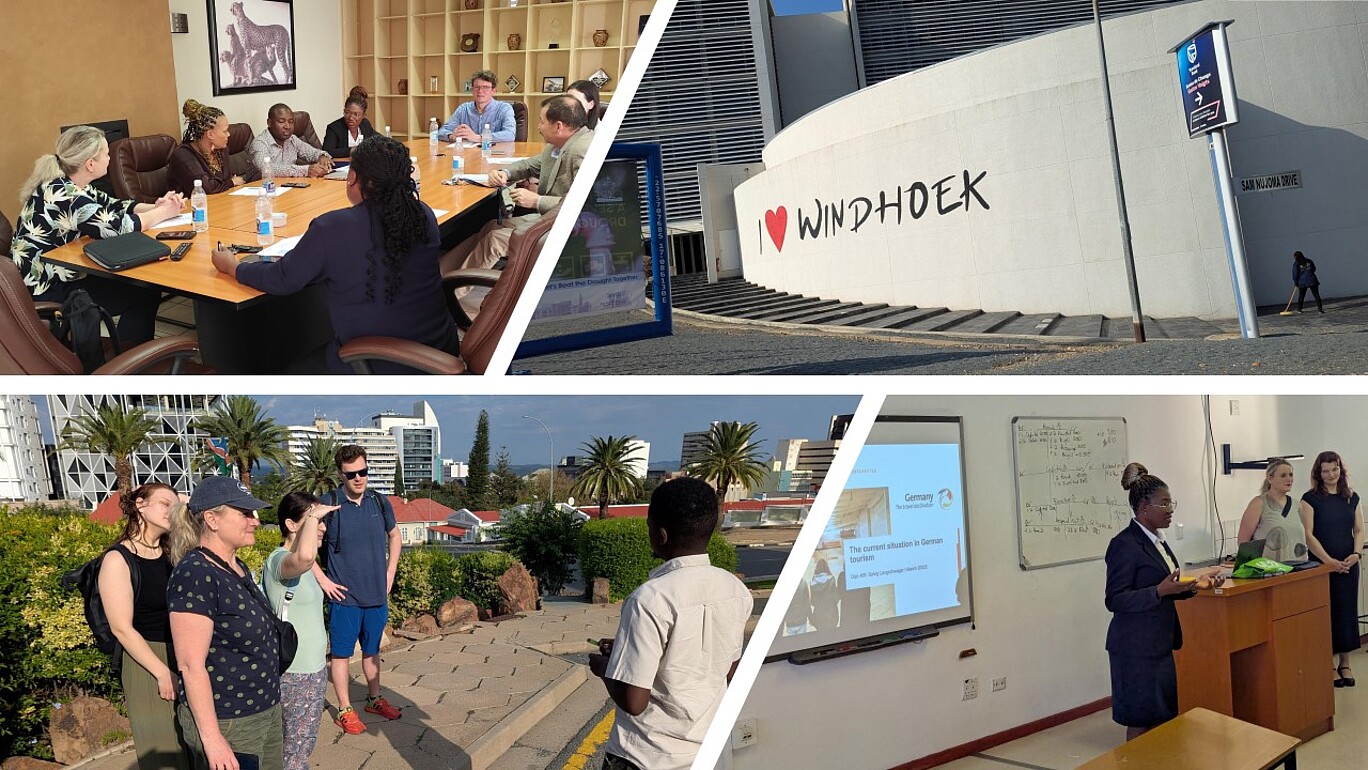
The picture collage documents impressions of an international exchange between the Namibia University of Science and Technology (NUST) and the Zittau/Görlitz University of Applied Sciences from Germany.  The first picture at the top left shows a meeting scene in a conference room. Nine people, including representatives from both universities, are sitting around a large wooden table. The atmosphere is concentrated, conversations are taking place and notes are being taken. The room is furnished with leather armchairs, in the background you can see a large shelf with traditional objects and a picture of an animal on the wall.  The second picture on the top right shows the exterior façade of a modern building with the words "I love Windhoek" written on it. The place is a well-known landmark of the Namibian capital Windhoek and symbolizes the local connection of the visit.  The third picture at the bottom left shows a small group of participants outdoors, taking part in a city tour or a walk. One woman points into the distance while the others listen attentively. Palm trees, modern office buildings and the Namibian national flag can be seen in the background - a clear reference to the urban context of the meeting.  The fourth picture on the bottom right shows a lecture situation in a classroom. A woman is giving a presentation entitled "The current situation in German tourism". There are mathematical formulas on the whiteboard behind her, while two other women - presumably participants in the project - are standing next to the lectern. Green cloth bags can be seen on a table, indicating an exchange of gifts from guests.

Setting off for Africa - International partnership on the move

International coordination and organizational issues - such as the Inter-Institutional Agreement or visa matters - were coordinated together with the International Relations Officers Mr. Nico Smit and Ms. Yolande Geises.

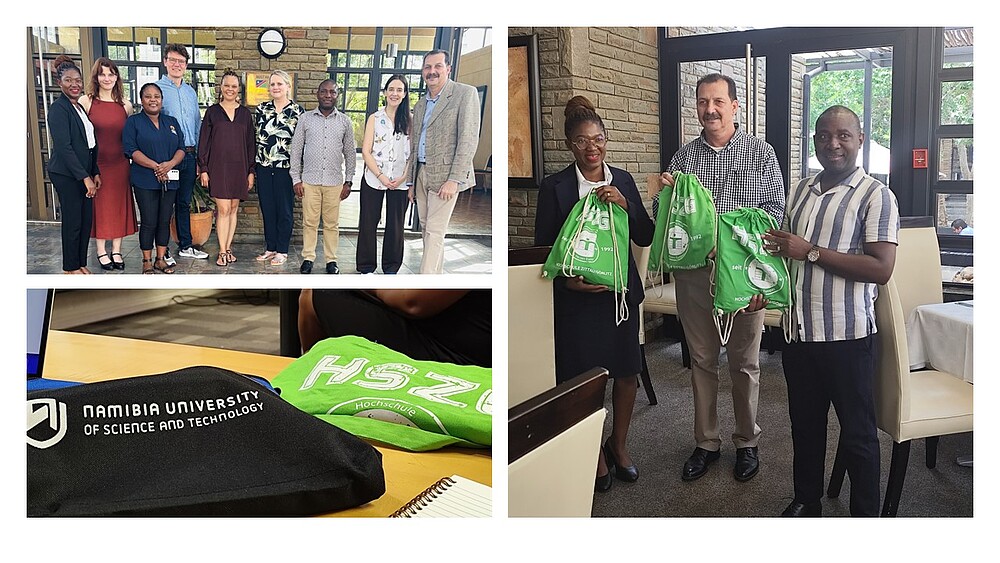
Lecturers from the Master's degree program in International Tourism Management were also actively involved in several classes / courses. Solvig Langschwager gave a lecture in English on "German tourists' profile and the German tourism product", Sebastian Benad spoke about "AI in Tourism and Smart Destinations". The lectures were met with great interest - so much so that additional chairs had to be spontaneously brought in for one event.

I was deeply impressed by the openness of our colleagues at the NUST and the professionalism of the students. Education is clearly understood here as a motor for social change.

Solvig Langschwager

Another highlight was the Community-Based Tourism Forum on 28 March, which was accompanied by Dr. Simon Chiutsi. Students, lecturers and representatives from the field discussed the future of sustainable tourism development in Namibia.

Intercultural experiences were not neglected either: from a visit to the Penduka Women's Project to city tours in Katutura and personal discussions with local CBT experts - every encounter broadened horizons and deepened understanding of Namibia's social and cultural diversity. The visit to Katutura, a township with over 250,000 people that is considered a symbol of social inequality, showed that this is not a matter of course - a defining moment for everyone involved.
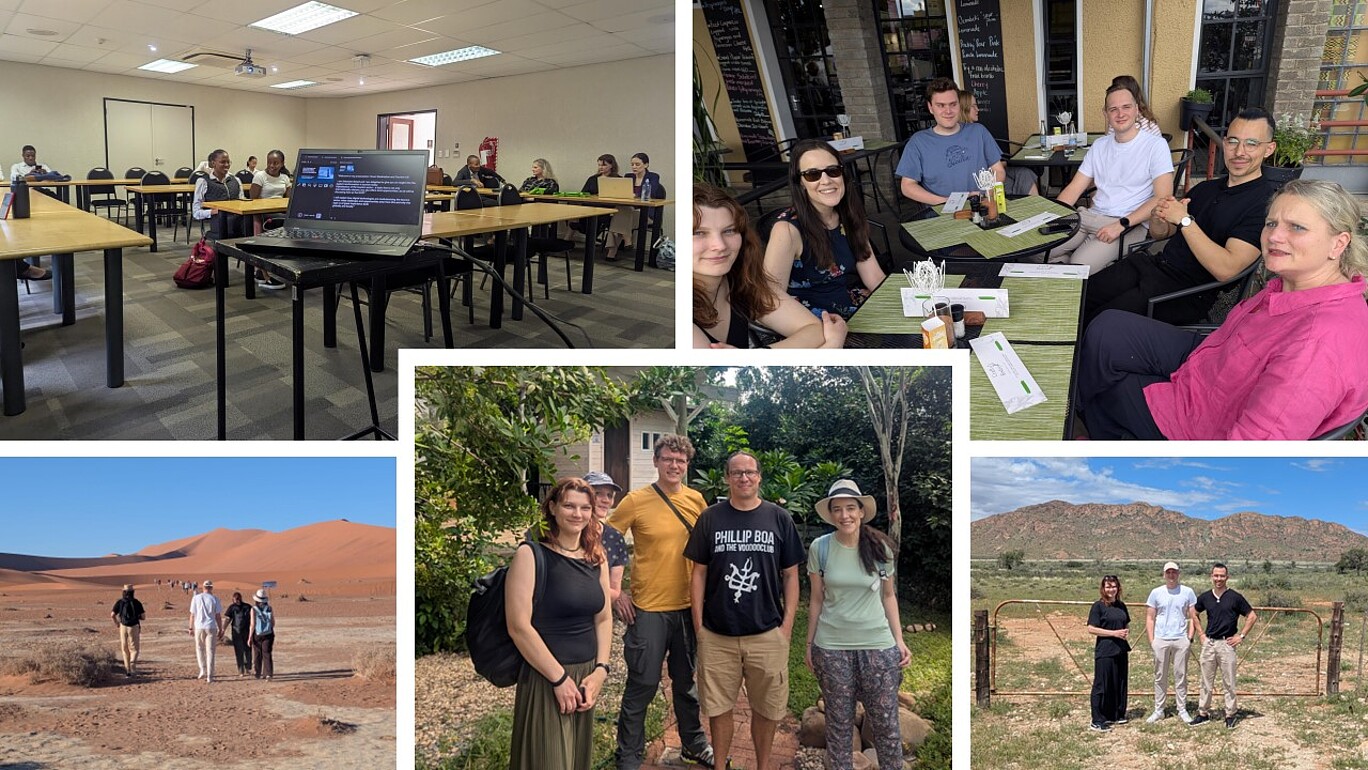
This picture collage documents the variety of activities within the framework of an exchange project between students and teachers from the Namibia University of Science and Technology and the Zittau/Görlitz University of Applied Sciences. The pictures show academic as well as cultural and scenic impressions from Namibia.  The first picture top left shows a seminar room with participants taking part in a lecture or training course. In the foreground, a laptop can be seen on a table, apparently being used for a presentation. The participants appear attentive and interested.  The second picture, top right, shows a group of students and lecturers having lunch together in a restaurant with an outdoor seating area. The atmosphere is relaxed, there is laughter and lively discussion - a moment of exchange outside the formal program.  The picture below left shows a group of people walking through the Namib desert. The view is of red sand dunes in the background, suggesting an excursion to the famous Sossusvlei dune area - an impressive nature experience as part of the program.  The picture in the center below shows several participants in front of a green background, presumably in front of accommodation or an educational institution. The group is posing for a group photo, which conveys a friendly and open atmosphere.  The picture at the bottom right shows three people in front of a farm gate with a view of a hilly, green landscape. The rural character of the surroundings suggests an excursion into the Namibian hinterland, possibly in the context of tourism, environmental or land use issues.

Responsible tourism - excursion through a land of contrasts

After the official part, the second stage began: an expert-guided excursion to selected CBT initiatives in the country. The trip took us through a wide variety of regions - from the capital to the Namib Desert and the Etosha National Park.

In projects such as the Swakopmund DRC Community Project, the Living Museum of the Ju/'Hoansi-San and Grootberg Lodge, it became clear how CBT models work in Namibia: Tourist offers are developed and implemented together with local communities, which not only creates jobs but also preserves cultural identities.

For me, CBT means enabling participation, anchoring value creation locally and protecting identities. And that is exactly what we have experienced with projects such as Penduka or Grootberg Lodge.

Sebastian Benad
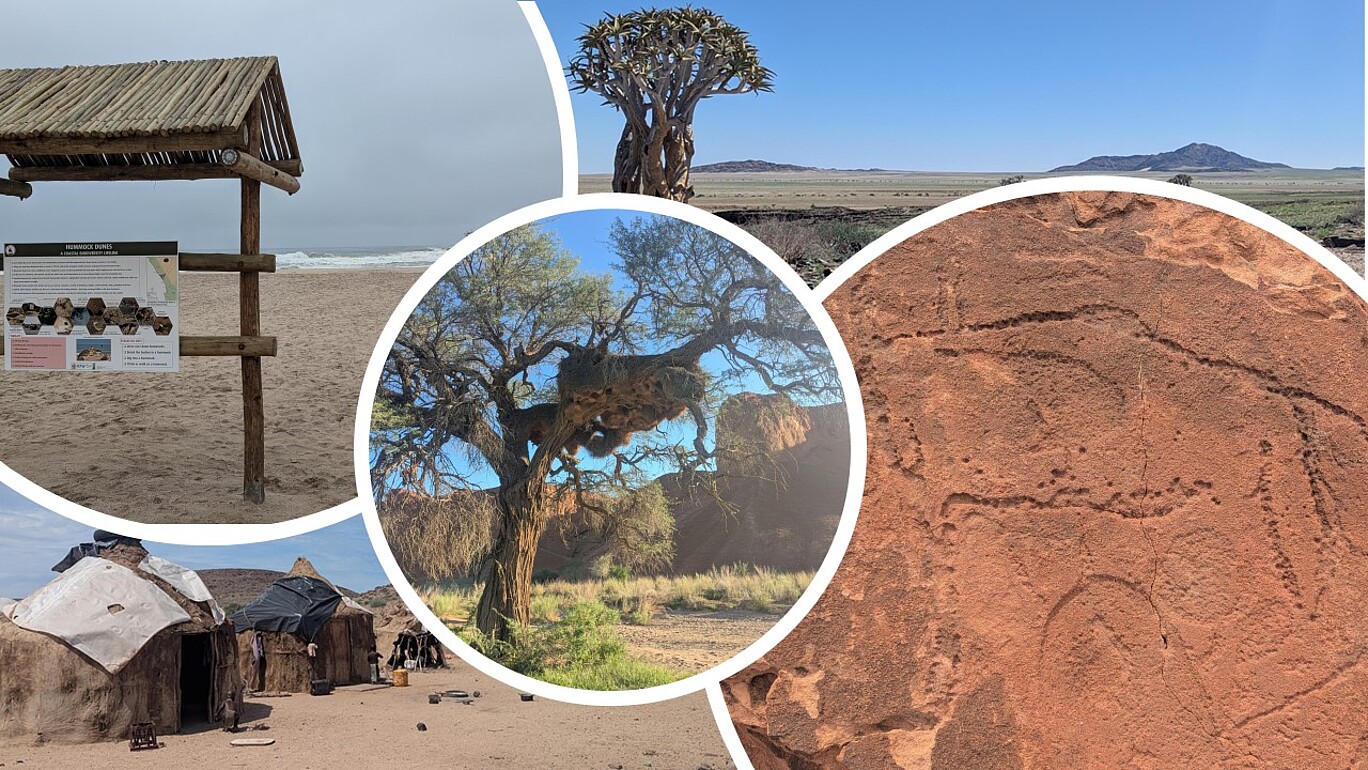
This collage shows various cultural and scenic impressions from Namibia and illustrates the diversity of natural and cultural areas that were explored as part of the academic exchange.  At the top left is a sign on the beach of the Skeleton Coast. The sign reads "Hummock Dunes" and provides information about the special features of the local ecosystem. Behind it stretches the misty Atlantic Ocean with its rough surf - typical of this remote coastal region in western Namibia.  At the top right is a single quiver tree (Aloe dichotoma) in a vast landscape. The tree symbolizes the dry climate and the resilience of the flora in the Namibian semi-desert.  In the lower left area, a traditional hut settlement can be seen - presumably from the environment of an indigenous tribe such as the Himba or Damara. The dwellings are made of natural materials such as wood, clay and tarpaulins.  The central image shows a large tree with a huge, tree-dwelling nest, which was probably built by settler weavers - small birds known for their imposing communal buildings. In the background, red rocks glow in the morning sun.  At the bottom right is a detailed photo of a rock engraving (petroglyph) depicting one or more animal figures. Such prehistoric petroglyphs are widespread in Namibia and bear witness to a long history of human settlement, especially in regions such as Twyfelfontein.

At the same time, the trip confronted the participants with the harsh reality of unequal living conditions. The visit to a Himba village gave everyone an impressive demonstration of how deep the gap can be between touristy staging and actual everyday life. The group reacted with respect and restraint - and donated almost all the food and water they had brought with them to the people of the village.

The experience was deeply moving - a moment that taught us humility and clearly demonstrated our responsibility as tourists and university members.

Master's student from the International Tourism Management program (anonymized)

In addition to technical depth, the trip was characterized by nature experiences such as sunrises over the dunes of Sossusvlei or encounters with desert elephants - not as a "safari", but as part of a holistic view of sustainable tourism development. Particularly impressive: the exploration of the Welwitschia Drive, the encounter with the 1500-year-old desert plant and stargazing at night with UV light in search of fluorescent scorpions. Spontaneous relief efforts - such as supporting exhausted cyclists in a desert race - also showed how well the travel experience and local commitment could be combined.
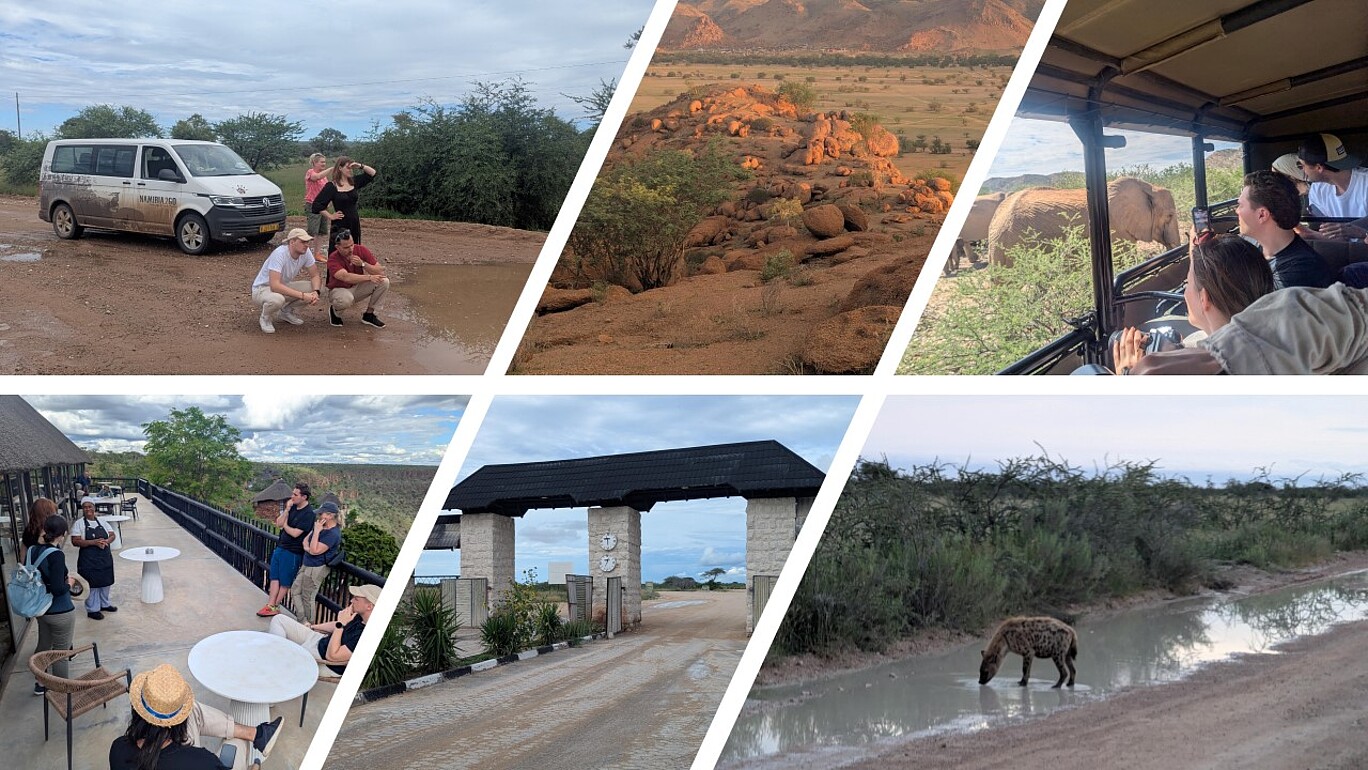
The picture collage conveys impressions of an excursion to a game reserve or safari lodge in Namibia, where the participants were able to experience nature observations as well as relaxation and hospitality.  The first picture on the top left shows a small group in front of a coach labeled "Namibia2Go" standing on a muddy road. Two people are posing in a crouch, while others are looking out into the landscape - a typical moment during an exploration tour through the Namibian hinterland.  The top middle picture shows a typical Namibian landscape: reddish glowing granite rocks in a wide plain, interspersed with individual trees and bushes. The scene appears calm and untouched.  At the top right is a scene from an open safari vehicle in which young adults are watching a group of elephants spellbound. The animals are very close to the vehicle - an impressive experience of nature that is captured on camera.  At the bottom left is a lodge terrace with a view of a valley. Guests are sitting at tables or standing at the railing, some are chatting with the staff. The atmosphere is relaxed and friendly.  The middle picture below shows an entrance portal made of natural stone with a gate - presumably the entrance to a lodge or a game reserve.  At the bottom right, a hyena can be seen at a waterhole. The animal is drinking from a puddle on the slope, surrounded by thorn bushes - a rare moment of wildlife spotting at dusk.

Outlook - sustainability and exchange as a strategy for the future

Namibiareise 2025 is more than just a single project - it is the start of a long-term cooperation that combines teaching, research and social commitment. The envisaged partnership between the HSZG and NUST will contribute to the internationalization strategy of the F-MK faculty that goes far beyond mobility figures.

Further steps are already planned in the follow-up: A return visit by Namibian lecturers to Görlitz, joint projects on CBT research and increased involvement of students from both universities in the teaching formats of the Master's degree course in International Tourism Management. This offers the HSZG the opportunity to further develop its practical orientation and value orientation in an international framework.
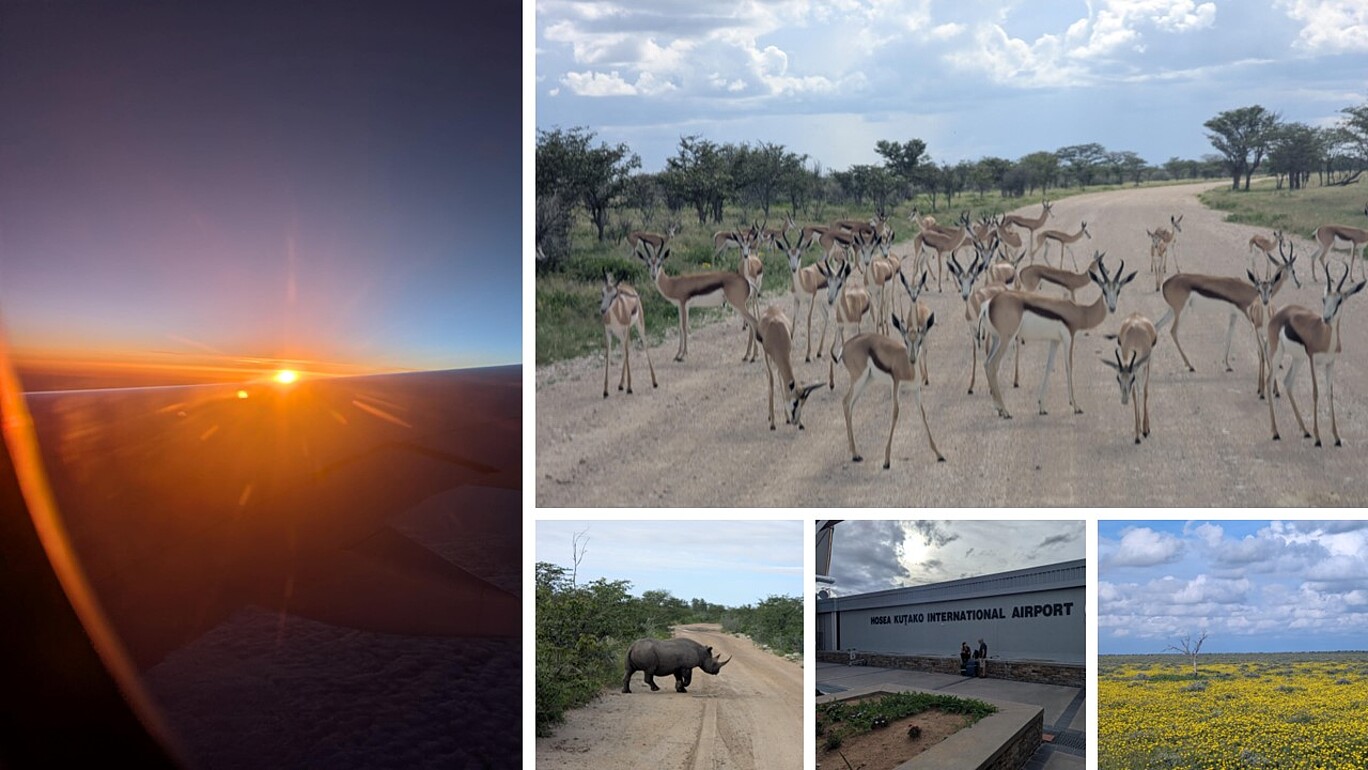
This collage visually summarizes the farewell to an impressive Namibia trip - with moments from the air, from the animal world and from the return journey.  The large picture on the left shows a spectacular sunrise from the airplane window, taken above the clouds. The wing tip is visible, while the warm light of the rising sun bathes the sky in shades of orange and purple - a symbolic moment of the return journey and reflection.  On the top right, a herd of springbok can be seen crossing a dirt road in a Namibian game park. Some of the animals are looking directly into the camera - a typical scene from the open savannah terrain, which is known for its abundant wildlife.  At the bottom left, a single rhino can be seen on a track amidst dense vegetation. The image underlines the respect and fascination of encountering wild animals in their natural habitat.  In the center below you can see the entrance area of Hosea Kutako International Airport near Windhoek. The photo shows travelers in front of the building - a silent indication of arrival or departure.  At the bottom right, a landscape image with an expansive meadow full of yellow wildflowers rounds off the collage. The sky is partly cloudy, a single bare tree stands in contrast to the colorful area - a peaceful, almost poetic degree of a multifaceted stay in Namibia.

The trip not only broadened horizons, but also built bridges - between continents, disciplines and perspectives. Community-based tourism is not only understood as a tourism concept, but also as an approach to education, participation and sustainable development.

Professional Contact Person

Photo: Dipl.-Kffr. Solvig Langschwager
Dipl.-Kffr.
Solvig Langschwager
Faculty of Managerial and Cultural Studies
02826 Görlitz
Furtstrasse 3
Building G IV, Room 2.19
2nd upper floor
+49 3581 374-4266