
A travel report about Brazil
by Jasmin Lange
"We have an extremely unjust society in Brazil.
We live with racial segregation.
There are Indians and blacks.
And there is an elite in society
without any responsibility for the country
in which they live."
<cite> (Luiz Ruffato) </cite>
We are a group of social work students, SWb17, and in February 2020 we flew to Brazil for five weeks as part of our project study program "Borderless Social Work" to support various population groups. In particular, we wanted to promote the aspects of ecotourism, cultural preservation and identity building both financially and through our actions. The trip consisted of various stages and topics, which I would now like to go into in more detail.
1) Project "Experience Rio Negro" (Jaraqui)
Brazil is the largest country in South America in terms of area. It is divided into 26 states and one federal district, the Distrito Federal. The largest state is Amazonas in northern Brazil, the smallest are the Distrito Federal and Sergipe in the northeast. The state of Amazonas is located in the northwest of Brazil. Its capital is Manaus. You have to travel a few hours by boat to the northwest on the Rio Negro river before you reach the small village of Jaraqui, which lies in the middle of the Brazilian jungle.
The inhabitants of the village live in harmony with nature and very traditionally. They belong to the "Caboclos" tribe. The tribes in the Amazon region do not have a uniform religion. Each tribe and sometimes even the families within a tribe belong to different religions. This results in a diverse culture surrounded by unique flora and fauna. A visitor center has been set up in Jaraqui so that an intercultural exchange can take place, for example with students like us. This was the idea of our professor Ms. Dassi, who also wanted to prevent people from moving to the next largest cities, such as Manaus.
Due to the lack of work and earning opportunities in Jaraqui, many people move to the city of Manaus. The women mostly earn their money through prostitution, while the men try to gain a foothold in the drug trade. The visitor center was founded to enable the "caboclos" to earn an income in Jaraqui. This center can accommodate 26 visitors with their own room and bathroom. The center is run by one family in three generations. The mission statement of the visitor center in Jaraqui not only includes socio-ecological, humanistic, nature-related and resource-conserving aspects, but also attaches great importance to the protection of the traditional culture of the "Caboclos". We students would like to get to know Brazilian culture and life in the jungle better there.
In Jaraqui, we were able to take part in various experiences with Roy, the owner of the visitor center. These included, for example, a hike through the jungle followed by an overnight stay in hammocks. We learned a lot about the local animal and plant species. The only animals our guide was afraid of were snakes and crocodiles, which lived in the swamp not far from our hammocks. Nature is the pharmacy of the "caboclos". There are trees, for example, whose bark helps against diarrhea or constipation if you chew it. There are trees whose sap can be used as a natural glue for boats, as well as a tree whose milky liquid can even be used as a substitute for breast milk if the mother of a child dies giving birth in a trunk. We were given ideas on how to survive in the rainforest despite wild animals and without supplies.
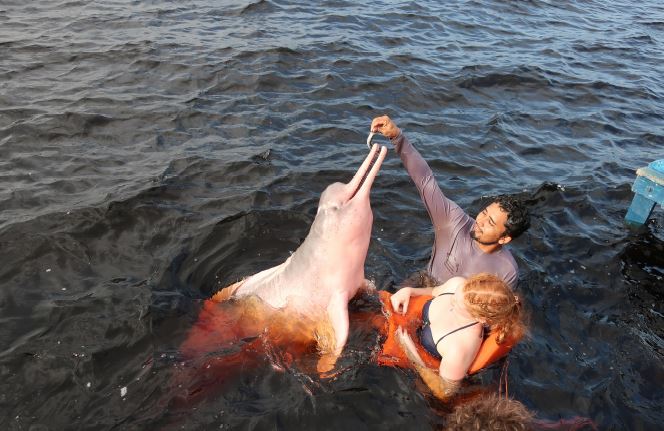
We learned that the only thing you really need is a good knife. We not only discovered the plant world, but also that of the animals, for example when swimming with river dolphins. We also saw sloths, monkeys and crocodiles. We learned how to make acai juice. Acai is a Brazilian superfood that is comparable to the European aronia berry and tastes slightly tart. The acai ice cream with fresh fruit tastes fantastic. We also broadened our culinary horizons with the breadfruit (tastes like potato), the Indian cheese (an avocado seed with orange flesh similar to pumpkin) and the tiger fish (measures one meter). It should be noted that the fruit and vegetables taste much more intense than in Europe.
Intercultural exchange Acai berriesJungle hike with Seu ManoelSwimming with river dolphins
We were also able to get to know the traditions of the indigenous Brazilian women and learn more about life on the Rio Negro when we went on an intercultural exchange with a school. The indigenous children are also taught there. Their involvement is good in that they can contribute their knowledge, for example about animal sounds. In this way, their knowledge and origins are appreciated and valued. We organized an afternoon with various games and crafts with the children.
Another intercultural experience that students at our university were able to experience for the first time was a visit to a village, where we were able to come into contact with the villagers in a very low-threshold way. The setting was a soccer match, which was met with great enthusiasm. The Brazilians and the "dolphins" (as
Europeans are called because they resemble pink river dolphins) played soccer side by side. Words were not necessary. Everyone understood what was meant when everyone shouted "Run for goal!" in their own language. Of course, our knowledge of Portuguese was still an advantage. Those who didn't play soccer chased around the meadow with the younger children.
The women of the village also benefited from our visit, of course, as they were able to proudly present and sell their jewelry to us. They had spent days and weeks making earrings, bracelets and cooking spoons by hand from red brazilwood. This enabled us to support ecotourism financially here too. Another cultural exchange took place in the Indian village, for example, which Roy took us to by boat. We were allowed to watch the traditional dances and even take part in them. These dances are only performed for "ecotourists" and at special festivals. For this reason, it was a special honor for us.
A day in the Indian village
The Brazilian women from the Amazon not only shared their knowledge with us, but also taught us about the importance of preserving culture and nature in Brazil. The exchange enabled not only us, the students, but also the "caboclos" to broaden their horizons and learn more about other ways of life.
Positive experiences were made on all sides. The new insights have enabled the operators to further develop the visitor center and make it more profitable and attractive for future visitors. The trip also focused on breaking down prejudices and inhibitions. Every culture and every nation is subject to certain stereotypes, which should be reduced through encounters between travelers and river dwellers. It is also about getting to know each other without reservations and experiencing the Amazon way of life together. The preservation of their own way of life, culture and nature naturally also plays a role.
The "Borderless Social Work" project is not only intended to support the visitor center, but also the people in Jaraqui. This includes Seu Manoel, Roy's father-in-law. With a pension of the equivalent of around 17 euros a month, he can barely make a living. To make matters worse, one of his lower legs had to be removed due to diabetes. To support him, we took advantage of the tours and activities he offered. These included, for example, making bracelets, hairpins and knives from Brazilian wood under his guidance, exploring the rainforest, going canoeing... When we handed him the money we had collected, he was very touched and so were we, because we knew what it meant to him.
Intercultural cooking at the Pierre Verger Foundation (sweet dessert with coconut)
Capoeira course (martial arts) with instruments
2) Marcelene (Jaraqui)
We also donated some of the money raised to Marcelene, Seu Manoel's daughter, who wants to establish a social project in Jaraqui. She first studied social work in Manaus and then returned to her home country. Her idea is to pass on the (medical) knowledge of the older generation to the younger generation so that it is not lost. Furthermore, the young people are to be more involved by reforesting the Amazon rainforest in return for a wage. This would allow them to do something meaningful that also has a positive impact on our global climate. The aim is to reinforce the feeling that there is "one world" in which we are all responsible for each other.
3) Pierre Verger Foundation (Salvador)
In Salvador, we looked at Afro-Brazilian culture, which has its origins in the slave trade. In the 16th century, African slaves were brought to Latin America by Europeans to work on the plantations. 37% of all those affected came to Brazil as a result. The Pierre Verger Foundation in Salvador de Bahia focuses on precisely this population group, which is still affected by marginalization today. Verger was a photographer and was committed to imparting knowledge between Brazil and Africa so that Afro-Brazilians could learn about and understand their origins
and thus encourage positive identity formation.
The foundation preserves and disseminates his work and also aims to act as a cultural center. For example, research is carried out, free courses are offered for children and young people and Candomblé, the Afro-Brazilian religion, is lived with all its customs (e.g. music and dance). This offers the opportunity to experience the individual power of a supportive community. Our project was primarily aimed at providing financial support and getting to know the foundation so that courses, for example, can remain free of charge and the process of strengthening cultural identity is guaranteed.
The Pierre-Verger Foundation is currently experiencing difficult conditions, as funding for the individual courses was approved by the Ministry of Culture, but the current President of Brazil, Jair Bolsonaro, dissolved it without further ado. The foundation now survives solely on donations and a few sales of picture prints etc. The annual study trip enables the foundation to secure its existence for at least a few months longer. We were able to learn a lot about Pierre Verger's life by visiting the foundation. The French photographer was a reserved, self-deprecating man with a fine sense of humor. His sparsely furnished house contains around 62,000 neatly sorted negatives, which were exhibited, for example, in his exhibition "Gods in Exile". This house is now a museum that has been opened to the public. We were able to take part in various activities offered by the foundation.
These included not only a cooking course with a typical Brazilian dessert and an art course, but also a capoeira course. Capoeira is a Brazilian martial art that is accompanied by instruments, a choir and singing. When performed correctly, it can also be used as a form of self-defense. It is designed to boost participants' self-confidence and help combat bullying in schools. Capoeira courses are not permitted at all schools. In the library, which is open to the public, visitors to the foundation can read up on a wide range of topics, including Afro-Brazilian history. There is also a private library run by Verger, where the old books have to be cooled to 19 degrees.
A sewing course teaches illiterate women how to read by embroidering proverbs and texts on fabric. This gives them the tools they need to earn a living later on. Taking part in the foundation's activities was very instructive for us students. We learned more about the life and work of Pierre Verger and the conditions and adversities that the foundation has to contend with in Brazil. Of course, there was also the warm intercultural exchange with the foundation's employees and participants.
Boxes with negatives of Pierre Verger
4) Jorge (Salvador)
We also had an intercultural exchange with Jorge, a friend of Ms. Dassi who lives in Salvador. He told us his story and a lot of interesting things about the situation in Brazil. As a child, he had to contribute to his parents' living costs because his siblings were hungry. He now owns a house that he rents out. He started studying law again in middle age and successfully completed it. His dream is to build a children's home for the street children of Salvador. He cooked a delicious typical Brazilian meal for us with lots of meat and vegetables. We also supported Jorge financially.
5) Professional exchange with the UFBA (Salvador)
The "Universidade Federal da Bahia" is considered to be the best and most prestigious university in the whole of Bahia. It is a state university in Salvador. It was founded on April 8, 1946. With around 40,000 female students and 1,768 employees, this university is the fifth largest in the country. Only five percent of the professors are from Bahia, the remaining 95 percent come from other parts of Brazil.
During our study trip, we had a professional exchange with two colleagues from the Faculty of Social Sciences. They told us about the social work course at the UFBA and we informed them about the Zittau/Görlitz University of Applied Sciences. There are 40,000 female students studying at UFBA. 62 percent of all students are female, 38 percent are male. 55 percent of female students are black. This is a very good quota, as there is usually a lot of discrimination and 99 percent of dark-skinned people are to be found in the favelas and only one percent (!) in the universities. The number has only increased in the last ten years.
The faculties of the UFBA are spread throughout Salvador. The largest courses of study are represented by medicine and engineering. They not only have the most students, but also the most female professors. Anna-Maria, the coordinator for social work at the UFBA, explained the content of the social work course, which has 350 students. The Bachelor's degree in Social Work has been around for 10 years, the Master's degree for just one year. Before that, all social work courses were private. In the past, the Abitur was the only admission requirement for starting a degree course, but for the past seven years an additional admission procedure has had to be completed.
The professors on the social work course are a total of 19 women and one man. In order to obtain a professorship, you have to complete a Bachelor's degree in Social Work. This takes four years. The two-year Master's degree does not necessarily have to be in social work, but can also be in another subject area. The doctorate comprises two years in a sub-area of social work. To become a professor, you do not need five years of practical experience as in Germany. The so-called post-doctorate corresponds to the German doctorate. The Bachelor of Social Work at the UFBA comprises eight semesters. The course includes an internship of 164 hours as well as two days of supervision per week. At the Zittau/Görlitz University of Applied Sciences, on the other hand, there are two semesters of work placement, each with 720 hours.
At UFBA, the link between theory and practice is very important, which is why theories and methods are closely interlinked in the curriculum. The module plan is similar to that of our university. There are modules on scientific work, sociology, theory and methods, social policy, etc. In addition, there is, for example, the module "Profession with State and Market", as well as "Politics and Social Support". The UFBA teaches under difficult conditions, as funding for universities has been cut despite high inflation. The universities are seen as the enemy by the state and the president and are treated as such. If students disagree with a professor's statements, for example, they can report him or her or sue him or her. What makes matters worse is the recently introduced scale from seven (very good) to zero (very bad). The courses that perform the worst will have their funding cut or will be cut completely. This means that the social work course is put to the test every year. There are more private than public universities in Bahia. Foreign students are supported by appropriate programs and are welcome at the universities.
Public library with books on Afro-Brazilian history, for example
The exchange with the UFBA was very instructive for us students from Germany and also frightening to see how the universities are dependent on politics and the current president.
6) "Chapadas Diamantinas" National Park
We also supported the ecotourism that we promoted in Jaraqui in the Amazon region in the "Chapadas Diamantinas" National Park. This mountain range was once home to countless diamonds, as this area has alternated between desert and ocean throughout history. The pressure caused diamonds to form inside the compressed stones. These were mined by diamond diggers. Diamonds were the city's most important source of money. When there were no more treasures left, the local economy collapsed. From then on, people had to finance themselves from other sources and often ended up in problematic situations such as prostitution or drug dealing. The model of ecotourism has existed in the national park for around 30 years and is therefore also relevant for us as social work students, as we were able to help the local people's economic advancement through our visit, for example by paying for a tour with a local, such as at the Gruta da Marota.
The stalactite cave is located on the property of a family that has embraced the concept of ecotourism. They earn their living with guided tours of the cave and a typical Brazilian lunch afterwards. Our guide Julio, the owner of the accommodation where we were staying, organized the tours in such a way that we were able to support many families in this way, e.g. on waterfall tours. Ecotourism is intended to combat social problems. In general, this type of tourism is intended to stimulate intercultural exchange and provide an insight into different ideals of life.
Gruta da Marota" stalactite cave
85 meter waterfall "Poco Azul" cave
Polished diamonds of the "Chapadas Diamantinas"
Conclusion
The study trip to Brazil was a unique experience for all of us, which not only broadened our horizons from a professional and intercultural perspective, but also allowed us to experience the Brazilian flora and fauna, as well as the incredibly delicious cuisine.
We would like to thank PROMOS for this opportunity!