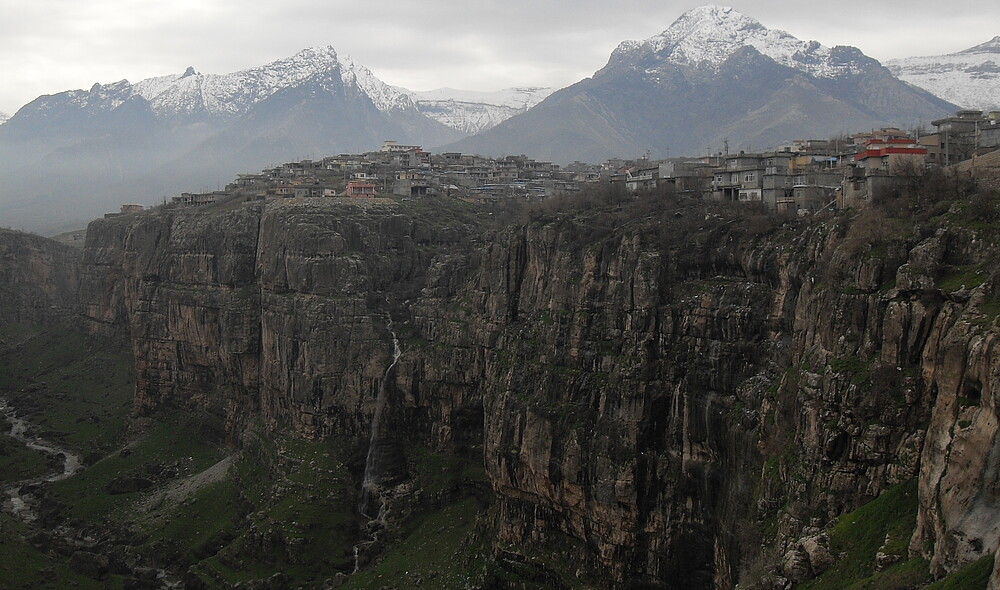
We welcome Kai, who was in Iraq from September to December 2012, to his first lesson on "Kurdish for beginners". [caption id="attachment_379" align="alignleft" width="177"] Welcome to Iraq[/caption]Before I started my semester abroad, I had to put up with being asked in Germany why I was going to Iraq of all places, whether I was tired of life and what this Kurdistan was anyway. The fact that my new fellow students at the American University of Iraq, Sulaimani, shook their heads in similar disbelief surprised me a little at first. As the first exchange student at this young institution in the Kurdish north of Iraq, I also had to face various questions here. Whether I had a Kurdish or Arab background, how I had become aware of the university and what my motivation was for wanting to spend my semester abroad in a region that was no longer in crisis but was nevertheless undergoing massive change. After various incredulous attempts to explain, which touched on the interactions between culture, economy and politics as well as the interesting political situation in the Kurdish region, I quickly switched to a simple but genuine "curiosity". This was satisfactory, for my new fellow students and lecturers as well as for me, as it simply summed up my entire academic, cultural and personal decision-making process."So, how was it?" is about the worst question you can ask a returnee. For better or worse, however, you have to face it, as not everyone who commits such a verbal-emotional crime against you expects an equally indifferent answer. So: it was exciting! For three and a half months, I studied courses such as "History of the Middle East", "International Trade and Finance", "Comparative Environmental Politics " and "International Relations", got to know the US university system and the Kurdish work ethic and had many exciting discussions, all of which sooner or later ended in political debates. The students at this leading institution in Iraq have firm opinions, a strong will and perseverance, partly due to their own fates but to an even greater extent due to the experiences of their relatives. After decades of oppression by Saddam Hussain, various wars in the region and a bloody Kurdish civil war, it didn't seem strange to me that everyone was talking about politics at this time. For the first time in history, the Kurds in Iraq have the long-term prospect of a self-governing region or even their own state. And even if, apart from the oil boom, not everything is going perfectly so far, I studied with people who are proud to be able to help shape and move Kurdistan and Iraq these days - in politics, the civil service, civil society or the private sector.[caption id="attachment_380" align="alignnone" width="501"]
 American University of Iraq, Sulaimani[/caption] Even though at first glance you could say that I didn't do much for my cultural management studies this semester, I not only furthered my education through my own studies on international copyright law and cultural aspects of conflicts in the various courses, I benefited much more from living in a new environment that was previously unknown to me. I seized every opportunity to see a concert or an exhibition, went hiking and camping in the Kurdish mountains and talked at length with mullahs and cab drivers - if that's not culture, what is? you can't expect a party semester in Kurdistan, Sulaimani is not an incredibly exciting city either, but you have to keep your ears open and listen, listen a lot, drink tea and join in the discussions. Because what is happening there right now is a whirlwind of economic, political and cultural development. I am glad to have been able to experience a small part of it.