In the project work of the "Public Health" module, the healthcare managers work out ways to prevent illness - with practical tips and tricks for you at home!
Jingle bells, jingle bells, jingle ... Wait, what? Where has the time gone? Autumn was just here with its stormy winds and yellow-red colors and suddenly it smells like tangerines everywhere and the neighbors are hanging their five-square-meter balconies with 20 fairy lights and flashing little men. The Christmas season is here and, like so many things this year, it will not be as we know it. Unfortunately, due to the high number of cases in connection with the pandemic, we are subject to stricter restrictions. So we will be spending the festive season with fewer family members. Some will also go into home isolation before the holidays to minimize the chance of infection. Because what is the most important thing in this world? Our health. Without it, everything is nothing and that's what the pandemic is making us feel most acutely at the moment. But what can we actually do to maintain our own health? How can you do something good for yourself? How can you strengthen your immune system in a simple and natural way? In this blog post, I will answer these and many other questions that are no doubt on your mind right now (I know, you can hardly stand the suspense and want answers, I'm already hurrying ...). Finally, you will also find selected tips and tricks for prevention that you can implement immediately. Grab a tangerine, a cookie or two and a hot chocolate or tea (mulled wine is also allowed). Make yourself really comfortable!
There's no question that health is one of the most important, if not THE most important asset. Now that the flu season has started in the fall and winter anyway, we need to pay particular attention to our immune system. The phase of the pandemic that we are unfortunately currently in does not defuse the situation, of course. The fact that many businesses have had to close means that some of us are no longer able to do sports in clubs or gyms, for example, and thus actively promote our health. For many of us, the coronavirus crisis also means a huge psychological burden, as there is simply no social interaction or we are currently under a lot of pressure in our private lives, e.g. due to caring for and looking after relatives. So many other factors are making life difficult for us at the moment. But what can we do ourselves to maintain our physical and mental health despite the coronavirus-related restrictions? This is what students are currently investigating as part of the "Public Health" module on the health care management course. The project therefore revolves around prevention services for students at our university during the pandemic.
"In all these years, I think this is the most exciting and beautiful experiment I've ever done with students in their first semester. We are on a journey of discovery together,"
says Ms. Wauer, lecturer and head of the project.
Since December, the students have been in the trial phase of the measure, which they were able to choose themselves. The research on this will form part of their short academic paper, which they have to submit at the end of the module. The topics are varied and range from sleep hygiene, eating and drinking habits and promoting exercise to reducing cell phone use. Of course, in contrast to the last article (you can find the link below), the project is at an advanced stage. In the broadest sense, it is currently about setting up a structure to implement the chosen measure. Defining the criteria under which your own observation should take place and which should be analyzed afterwards also plays a decisive role. For example, students who are looking at exercise as a preventative challenge must first set themselves a goal:
I will now spend half an hour in the fresh air every day.
The positive and negative experiences gained each day are written down in a diary. Have I noticed an improvement in the quality of my work after spending time in the fresh air? Did I find it difficult to make time for it today? Was I not able to concentrate on the activity but was on my cell phone the whole time? What about my intrinsic motivation? How does my environment react? All these observations are written down in the diary in the evening and analyzed at the end of the five weeks in which the students try out the chosen measure.
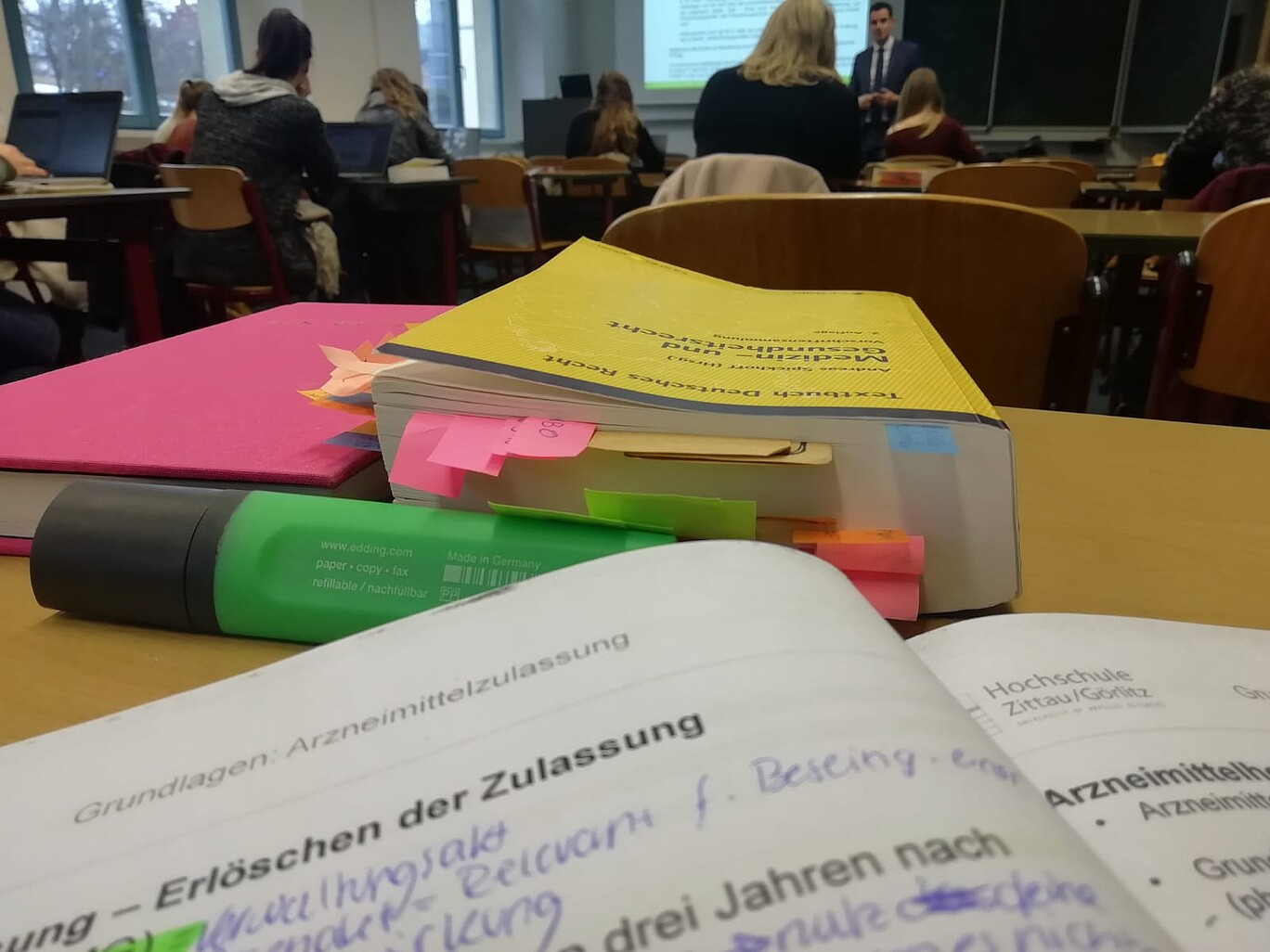
During the trial phase, the theory part of the course is also covered. As the majority of students currently taking the module are first-year students, we can all imagine the confusion and the thought "I'm so far away from understanding this" ringing loudly in our heads. The huge subject area now has to be reduced to the bare essentials - no easy task. In addition, the realization must grow: even from zero results and failures you can draw a lot of conclusions about the overall result. Ms. Wauer also emphasizes:
"Of course, you don't have to hope that anything will permanently change here in terms of behavioral and relational prevention. That has to become clear first, but it is at least an approach. Because, no matter what prevention approaches I want to take in the future: I have to do them, I have to start somewhere first. And that's the important thing for students to learn. Of course, basic knowledge about prevention and your own body is essential, but what's most important is doing it."
The students are also convinced of the impact of the project. Especially now, during the coronavirus crisis, it's good to be consciously "forced" to do something to improve your health, says Paul. He is one of the first students on our course. He also thinks the diary is a good thing, as otherwise you quickly forget what you've experienced.
"I find it even more recommendable and enriching to carry out such a project in these difficult and challenging times. Health in particular has suffered greatly under coronavirus conditions. Social contacts have been restricted, sports activities have been canceled and much more. An experiment like this is very good at the moment," says Paul.
In other words, it's all about understanding which screws you can turn and what this does to your own body, psyche and environment. Because we all live by example and sometimes we leave the path of our convictions because we want to meet the demands of everyday life. And that's okay. But if you realize that you're not feeling so good right now or you're not living up to your full potential, I have some tips and tricks for you on how you can quickly do something for yourself and your health.
Get out into the daylight for at least half an hour every day. Maybe you can incorporate it into your lunch break? It has been proven that direct exposure to daylight can prevent winter depression. It's even better if you go outside without having any goal in mind. In other words, just walk around aimlessly. By concentrating on your surroundings, for example the laughter of the children or the chirping of the birds, you give your brain a little break and live where you should be living: in the here and now.
"But you're also doing yourself a good turn when you go shopping on foot, for example. The retina, i.e. the eyes, perceive the light. We have a hormonal connection here," explains Ms. Wauer.
As we currently spend a lot of our time in front of our PCs, as some of our teaching takes place online (or you buy the odd present online, or Netflix or or or), our eyes are exposed to the so-called blue light from screens all the time. So you can either wish for blue light filter glasses for Christmas or an optician's voucher. But it would be even better if you didn't have any screens in front of you for an hour or two before you go to bed. This also means no cell phone (by the way, you should put it away even if you don't have a blue light; this relieves your brain as you are not constantly exposed to stimuli).
Ventilate the room thoroughly before sleeping so that the temperature is moderate. If you're too cold, have a hot cup of tea or make yourself comfortable under the covers with a hot water bottle. Our brain plays garbage collector at night and the waste that has accumulated in the brain is removed. But if you don't have enough oxygen in the room, the brain's motor is only running at half power. So perhaps it's even better to leave the window ajar.
If you sleep and work in the same room, make sure you clear away everything from your work. You can also pile it up so that it looks like it's finished in your mind. Finish the day's work so that the first thing you see in the morning isn't your unfinished short academic paper or the research you've started, but so that you can start the morning in a mindful and centered way. Allow yourself time in the morning to organize and structure yourself.
Drink sufficient fluids. Observe yourself for three days. How much do you drink? And when? There are hours when students often don't drink anything, but we demand maximum performance from our bodies and cells every day (yes, even thinking is exhausting). So why don't you drink a cup more in the morning and top up with plenty of fluids in the afternoon? 1.5 to 2 liters should be the norm. You shouldn't go below that. This will give them the environment they need to perform at their best every day.
Even if some people find it difficult, you should eat a snack in the morning. This can also be in the form of smoothies if you prefer something to drink in the morning. (But please don't buy them. Second-hand blenders are also quite cheap, as are fruit and vegetables. Otherwise, Christmas is just around the corner ;-) Ideally, your morning meal should also contain some fiber.
Routines are a strong anchor for the psyche. Once they are established, they cost little energy and free up time and mental space. So ask yourself what kind of routine you could establish. Would you like to do something good for yourself in the morning in the form of yoga or perhaps go for a jog in the evening, do a puzzle, cook or meditate? Listen to yourself and see what would do you good. But establish the new routine very slowly. Only do the new thing once a week until you realize: Oh, I could do it two or three times (this is called the Kaizen principle, by the way, another lesson learned). This way, you don't provoke demotivation in the first place and the chances of you sticking with it and establishing it in the long term are much higher.
At the beginning, however, you should start by taking time for yourself. This is often the start of something really big. Ask yourself: What is not the way you would like it to be? What could you change? You can and should take care of yourself.
In conclusion, all I can say is: see the circumstances as an opportunity. An opportunity to really spend this Christmas in peace and contemplation with your favorite people without having to rush from relative to relative. Relax on the couch with your parents, nibble on a cookie or two (or a whole bowl of cookies) and really take time for conversation, sharing, love and for yourself. Actively spend time with your family (but please adhere to the coronavirus regulations). Be mindful and look for the little moments of happiness that will show themselves to you this Christmas. It's not what we would have wished for. But let's make the best of it. And: take care of yourself and your health! I wish you and your loved ones a peaceful time and a good start to the new year.
Your Annelie Kolumna - roving reporter for the "Health care management" degree program