
We asked the students of the Faculty of Managerial and Cultural Studies about this topic. Find out more here!
Gendering at the university: an overview
Author and photos: Marie Weiß
"Gendern", from the English word gender , does not refer to the biological male/female, but to the social gender, which includes people's feelings and emotions. Gendering is therefore gender-inclusive language, which is intended to ensure a little more equality between the sexes. Since 2018, there has been a third gender option, "diverse", which includes all people who feel neither male nor female.
To gain a little insight into linguistics, I spoke to Prof. Muschner. She is a linguist, lecturer at our faculty and co-author of our university's gender guidelines.
My first question to her was: "Why is gender so important?". She explained to me that this was not a question for linguistics, but for the social sciences. Would you have known that?
This question was answered by one of our lecturers in the Faculty of Social Sciences, Prof. Kollmorgen:
Language has a lot to do with culture and thinking, it is intrinsically political (without just being political); we shape the social world through speaking as social action. Social developments determine and shape language change. However, it is important that social developments are also expressed in language change.
"Of course, gendering per se does not bring justice between the genders. Rather, gendering shows where women are already actively involved in shaping our present and future," said Prof. Muschner in response to my question as to whether gendering brings about justice between the sexes. A very apt answer to which there is nothing to add. In her opinion, it is not only important that women are taking on more and more positions of responsibility in our society, but also that we express this trend clearly in language.
Prof. Muschner told me that gendering remains voluntary at our university. She therefore sees no problems for students, as there is no obligation to use gender:
If you don't want to do it, you don't have to. If you would like to use gender but are still unsure, the university's gender guidelines can help. Prof. Muschner and the Equal Opportunities Officer at our university, Dr. Reinhold, will be happy to answer any questions you may have.
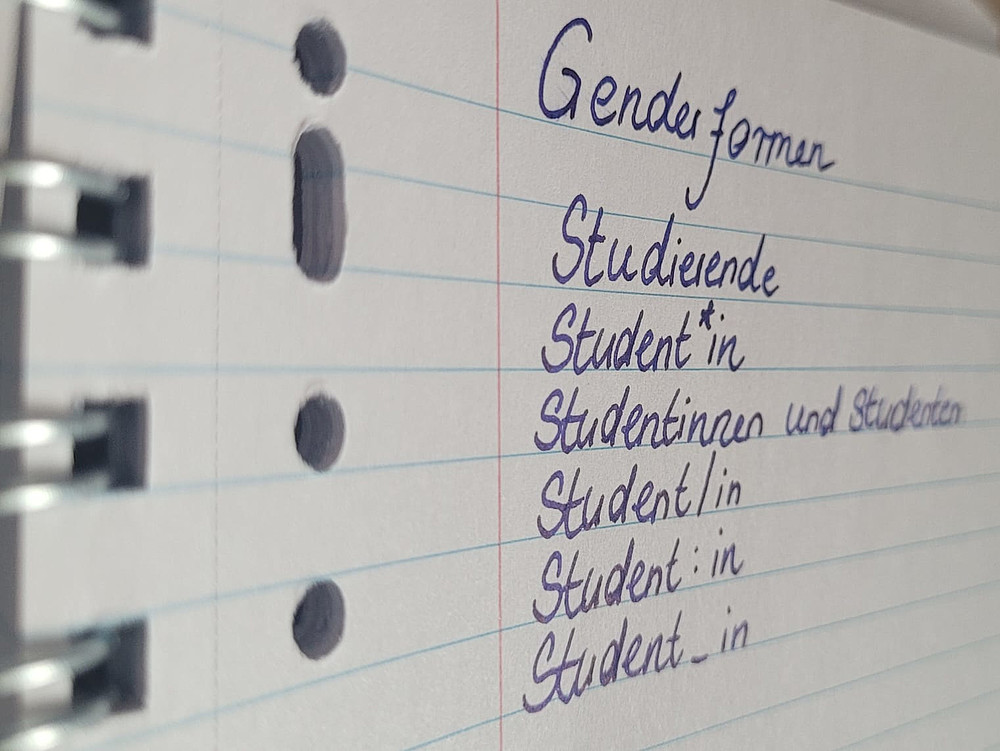
The following is an overview of gender-sensitive options using the word teacher as an example. It's very easy:
The highlight of the Zittau/Görlitz University of Applied Sciences gender guide is that at the end there is a glossary containing all the university-relevant terms that have already found their way into our everyday university life and public relations work.
To this end, we conducted a survey among the students of the Faculty of Managerial and Cultural Studies, in which around 15% of students took part.
Among other things, I asked whether gendering brings about justice between the sexes. The majority of respondents were of the opinion that it does not create justice.
The topic of gendering in language "seems to polarize". "Adjusting salaries between men and women would lead to more equality." Some respondents believe that some forms disrupt the flow of language, seem forced and are more degrading than the generic masculine.
Nevertheless, there are some students who believe that gendering ensures fairness: "When language is followed by action", "respect for women" and "creates respect for ALL", for example, are statements made by those in favor. One student is of the opinion that gendering ensures equality, but finds the huge media attention for this topic often exaggerated.
In general, gendering also seems less useful or necessary among the participants in the survey: the asterisk, for example, only emphasizes the difference between male and female.
"I think it's more important to help women in other areas first, before it comes to language. [...] As far as the world of work is concerned, women are still discriminated against in areas that affect everyday life more than gendered language. Since it feels like nothing is being changed about these problems and instead work is being done on "the right way of expressing oneself", it seems to me like a way of putting off being able to pretend that it is important to the government/society."
I personally find this statement from a student very moving. In my opinion, language is at least the beginning of the process of rethinking and we must never forget that language is always changing.
"It depends on the situation and can be adapted accordingly. But you don't have to use gender in every area."
In contrast, some even believe that gendering is urgently needed at our university and that we should find ways to ensure that it doesn't sound too forced. Neutral forms such as students are perfect for this.
Neutral forms are also the most popular way of using gender among respondents, as they are the least conspicuous in the flow of language. In the ranking of students, the asterisk follows, some prefer the couple form, some the slash, others the colon, but none of the respondents used the underscore. Some of the respondents believe that the majority find it difficult to use gender because of the many different forms and the many possibilities. Only 37% of those who took part in the survey use gender.
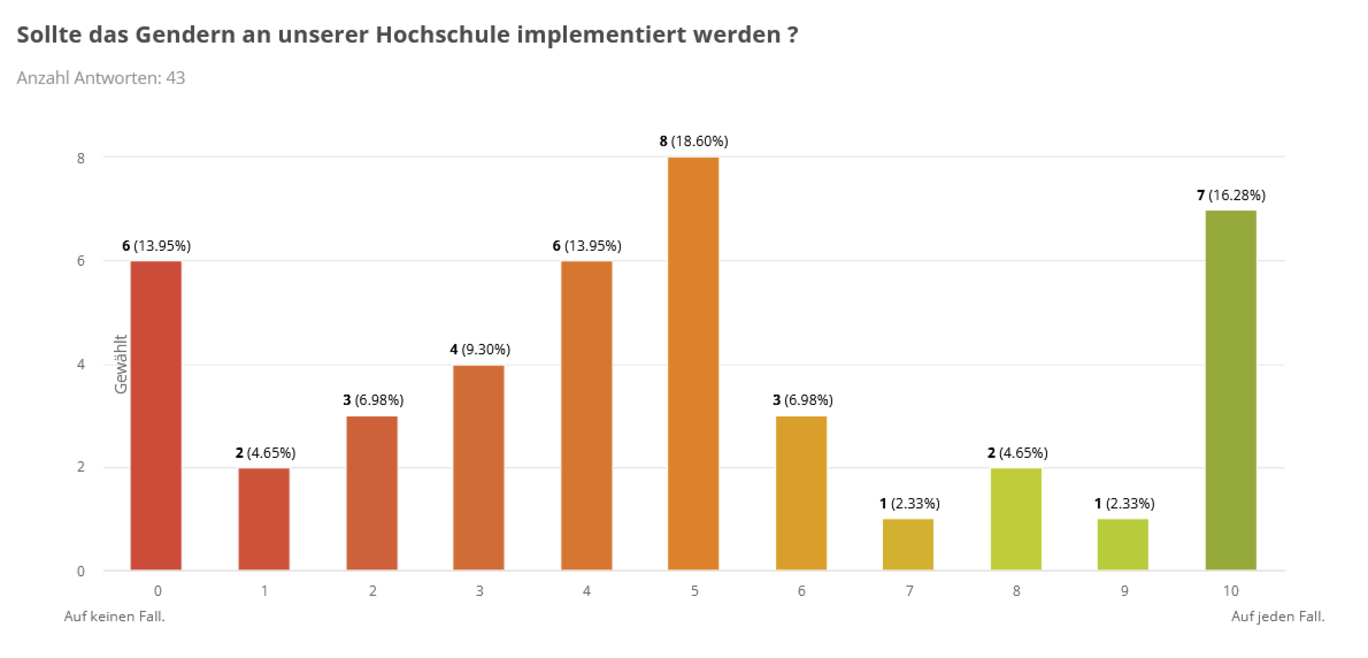
When asked whether gendering should be implemented at our university, the result is quite mixed. You can see the result in the following graphic.
What about the topic of gender and voluntariness, especially with regard to academic texts?
A total of twelve students responded to this question. The majority are in favor of gendering remaining voluntary and each individual person being free to decide whether and when they want to use gender in academic work. However, there are also other opinions, for example that voluntariness is not a solution and that there should be a clear, uniform regulation.
Overall, it can be said that the opinions of the students we surveyed are very diverse. Ultimately, we always have to decide for ourselves whether we want to use gender or not. In any case, it is advisable to take a closer look at the topic and simply give it a try: What is there to lose?