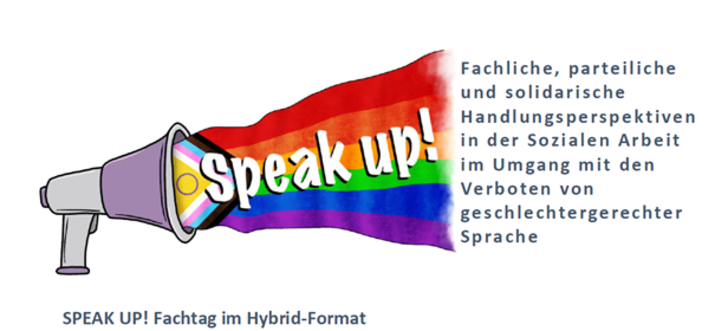
Professional, partisan and solidarity-based perspectives for action in social work in dealing with the prohibition of gender-equitable language
Just over a year ago, the Gender and Queer Studies Section of the German Society for Social Work published its statement "Why we will not abandon 'gendering with special characters'!". In doing so, the section expressed its concern about the public debates questioning the use of gender-equitable and discrimination-sensitive language and joined the critical positions of numerous colleagues from gender studies and gender equality officers. Since then, the discussion about the so-called "gender ban" has intensified further. Several federal states - including Bavaria, Brandenburg, Hesse, Rhineland-Palatinate, Saxony, Saxony-Anhalt and Schleswig-Holstein - have introduced regulations that restrict or even prohibit the use of gender-inclusive language with special characters in educational and administrative contexts.
These developments not only pose a challenge for practitioners, but also raise fundamental questions within the discipline and profession of social work: What role does and should discrimination-sensitive and inclusive language play, e.g. in connection with the perspective of addressee* orientation in social work? How can emancipatory and democratic strategies that are conveyed through language be defended, further developed and implemented despite political attacks?
Professional exchange
Against this backdrop, members of the Gender and Queer Studies in Social Work section organized an event together with the network "Verbinden & Verbünden - intersectional and queerfeminist perspectives in social work", the Zittau/Görlitz University of Applied Sciences, the Protestant University of Applied Sciences Darmstadt and the Gender and Women's Research Centre of the Hessian Universities (gFFZ).
As part of a hybrid symposium entitled "Speak up! Professional, partisan and solidarity-based perspectives for action in social work in dealing with the prohibition of gender-equitable language", discussion spaces were created to discuss the importance and possible uses of gender-equitable, inclusive and discrimination-sensitive language in social work. Professionals, students, representatives of initiatives, teachers and researchers entered into a dialog to develop common positions and (professional) policy strategies. Click here for the flyer of the symposium: https://f-s.hszg.de/fakultaet/fachtag-im-hybrid-format
Inspiring keynotes
The symposium, which was attended by over 200 people, was introduced by a social work perspective from Ioanna M. Menhard and Monique Ritter, in which the background to the symposium, disciplinary and interdisciplinary theoretical and empirical references as well as a professional policy positioning of social work were elaborated. This was followed by keynotes by Zara Jakob Pfeiffer, freelancespeaker, on power relations in the context of language and vulnerabilities. The focus was on the question: How do we negotiate visibility and why is it so difficult to speak without discrimination? and by Ulrike Lembke, feminist legal scholar. In her lecture, she dealt with "Language bans and gender discrimination" and examined the topic from a legal, constitutional and political (action) perspective.
Diverse workshops - a forum for exchange
In the afternoon, a total of 13 workshops on various dimensions, aspects and (impact) fields of gender-equitable language and its prohibitions were offered online and in person by speakers from practice and research as well as queer-feminist intersectional initiatives, associations and projects - mainly from Hesse and Saxony. The main topics here were gender-equitable educational work, addressing queer young people, ways of addressing refugees and asylum seekers, gender diversity and easy language, current language policies in everyday academic life, creative ways of dealing with gender bans, the needs of trans*, inter* and non-binary children and young people, effects on school social work, gender-equitable language and child welfare, as well as connecting and strengthening each other.
A look ahead
In order to take the discussions and results of the workshops forward, the participants were asked in the final round to formulate their key findings as demands for those responsible in politics.
In addition to the concrete demand to withdraw the language bans, it was also made clear that politicians should take the knowledge of the realities of life of marginalized groups and groups affected by violence seriously, recognize professionalism and expertise and endure social tensions and fields of negotiation and understand and positively accompany them in the sense of a democratic process.
To be continued ...
The discussion of gender-equitable language in social work shows that language is more than just a communicative tool - it is a central component of inclusion and justice.
The results and discussions of the symposium make it clear that social work in practice, profession and discipline continues to require active discussions to promote and further develop gender-equitable language. This also requires a critical approach to political decisions from a professional perspective, a clear position and solidarity with those affected by queer-hostile violence and the development of creative strategies for action. In 2025, we will continue our efforts to bundle energies and develop solidarity networks and speak (even) louder.
From the section "Gender and Queer Studies in Social Work" of the DGSA and the network "Connecting & Allying - Intersectional and Queerfeminist Perspectives in Social Work": Kerstin Balkow (she/her), Ioanna M. Menhard (she/her), Monique Ritter (she/her), Elke Schimpf (she/her)
Recommendations for further reading
Federal Trans* Association (BVT*): Underline, asterisk or colon? Why we write the way we write, www.bundesverband-trans.de/geschlechtergerechte_sprache/
German Association for the Blind and Visually Impaired (DBSV): Gendern, www.dbsv.org/gendern.html
Lucia Clara Rocktäschel (2020): Gendern in Leichter Sprache - eine Anleitung, www.genderleicht.de/gendern-in-leichter-sprache-anleitung/
Thomas Tews (2024): Banning gender-inclusive language? In the corset of binary gender. www.gender-blog.de/beitrag/geschlechtergerechte-sprache-verbieten-gendern
Inga Nüthen (2024): Is this still language or already authoritarian (gender) politics? https://geschichtedergegenwart.ch/ist-das-noch-sprache-oder-schon-autoritaere-geschlechter-politik/
Constitution blog: https://verfassungsblog.de/author/ulrike-lembke/
Yan Zirke (2023): How you can support non-binary young people. There are more than two genders - now what? What non-binary means and how educators can take a stand. https://www.geschlechtersensible-paedagogik.de/magazin/aus-der-praxis/wie-sie-nicht-binaere-junge-menschen-unterstuetzen-koennen/