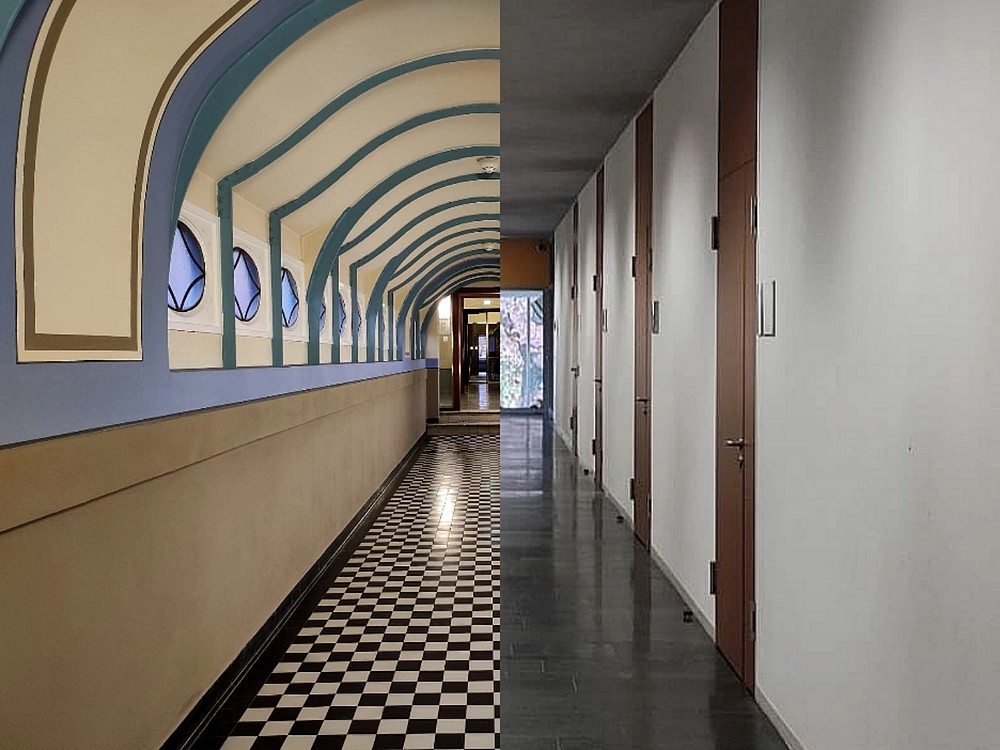
Our teaching buildings G I and G II could not be more different, but both contribute significantly to the atmosphere of studying at our faculty. By alternating teaching in both buildings, we never get bored in this respect.
Author: Susanna Marek
Photos: Susanna Marek
Studying at the Faculty of Managerial and Cultural Studies in Görlitz is characterized by teaching in two very different buildings. I'll show you what switching between two buildings can mean for students. First of all, however, you should know something about the history of the HSZG.
Our university can look back on a long tradition in education. The focus of both campuses was on construction and engineering. In 1992, the German Science Council decided to merge the Zittau University of Applied Sciences and the Görlitz School of Engineering for Electrical Engineering and Information Processing. After changes and expansion of the courses on offer, the Zittau/Görlitz University of Applied Sciences was born in 1997.
The students of our faculty have been taught at the Görlitz campus since 2012. Two of the buildings in which we F-MK students study could not be more different: House G II is an imposing old building with historical flair, while House G I is a modern new building in a futuristic style. So there is something for every taste!
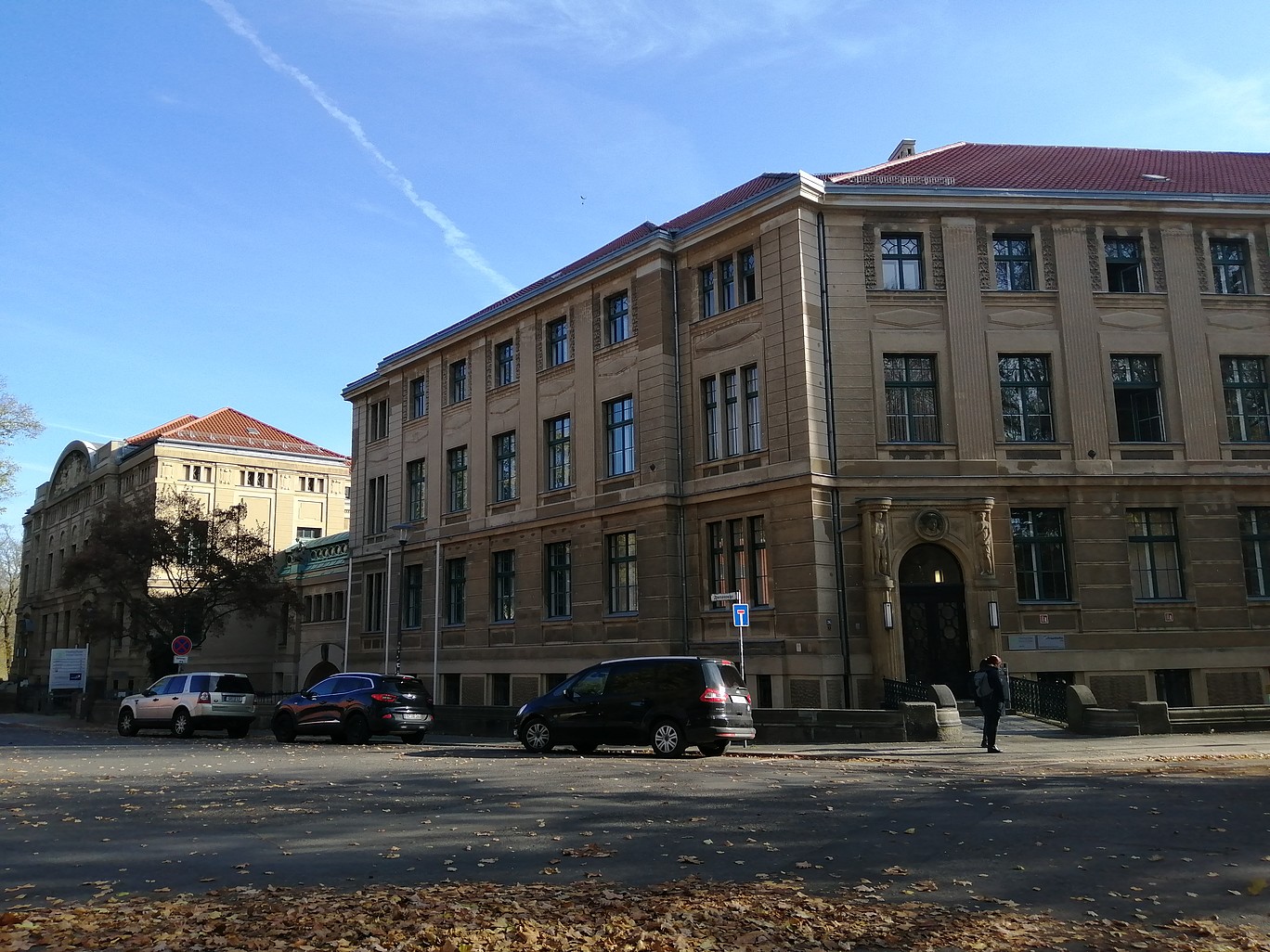
If you are interested in historical buildings, the G II building is the right place for you at our faculty. Below I will give you a brief outline of its history.
The building, designed by architect Paul Gerhard Röhr, was completed in 1914. It was commissioned by the Rothenburg insurance company, which then used the building for 30 years. It was therefore not designed as a teaching building and this can be seen in some places, but more on this later.
The "state engineering school" founded in 1898 lost access to its building in what is now the Polish part of Görlitz after the war as a result of the Oder - Neisse Agreement. The property of the Rothenburg insurance company was chosen as the new teaching building. In 1951, training began in the newly founded "Technical School for Rail Vehicle Construction" in the building on Brückenstraße. A year later, it shared the building with the "Engineering School for Electronics" (later known as the "Engineering School for Electronics and Information Processing"), which had also just been founded. Until reunification, trainees were taught mechanical engineering, electronics and IT at this location.
When the schools in Zittau and Görlitz were merged, the teaching building was also taken over, initially as a location for teaching computer science, later also for culture and management, among other things. Today, all students in the MK faculty have the privilege of being part of the long history of the G II teaching building for several hours a week.
But what makes the building so special, perhaps just its age? Of course not.
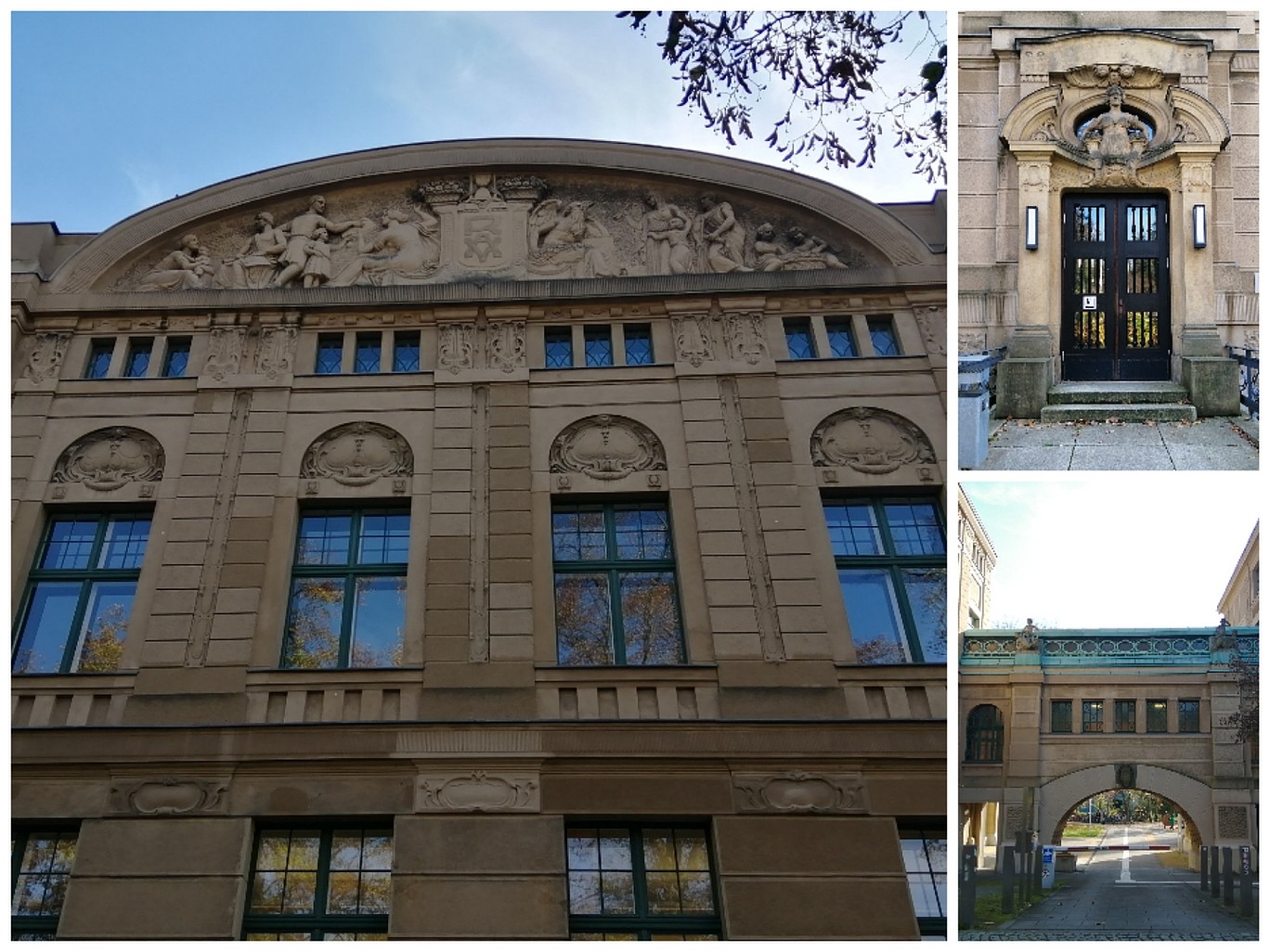
The building complex borders the city park. It is located on the corner of Brückenstraße and Furtstraße and consists of two houses connected by a two-storey corridor. This connection forms a courtyard entrance to the campus and is decorated with ornaments and two putti.
Both houses differ in their structure, but form a unit through variations of a common style. The architect designed the building complex in Art Nouveau style and also incorporated corresponding design elements in the interior, which can still be admired by us students today.
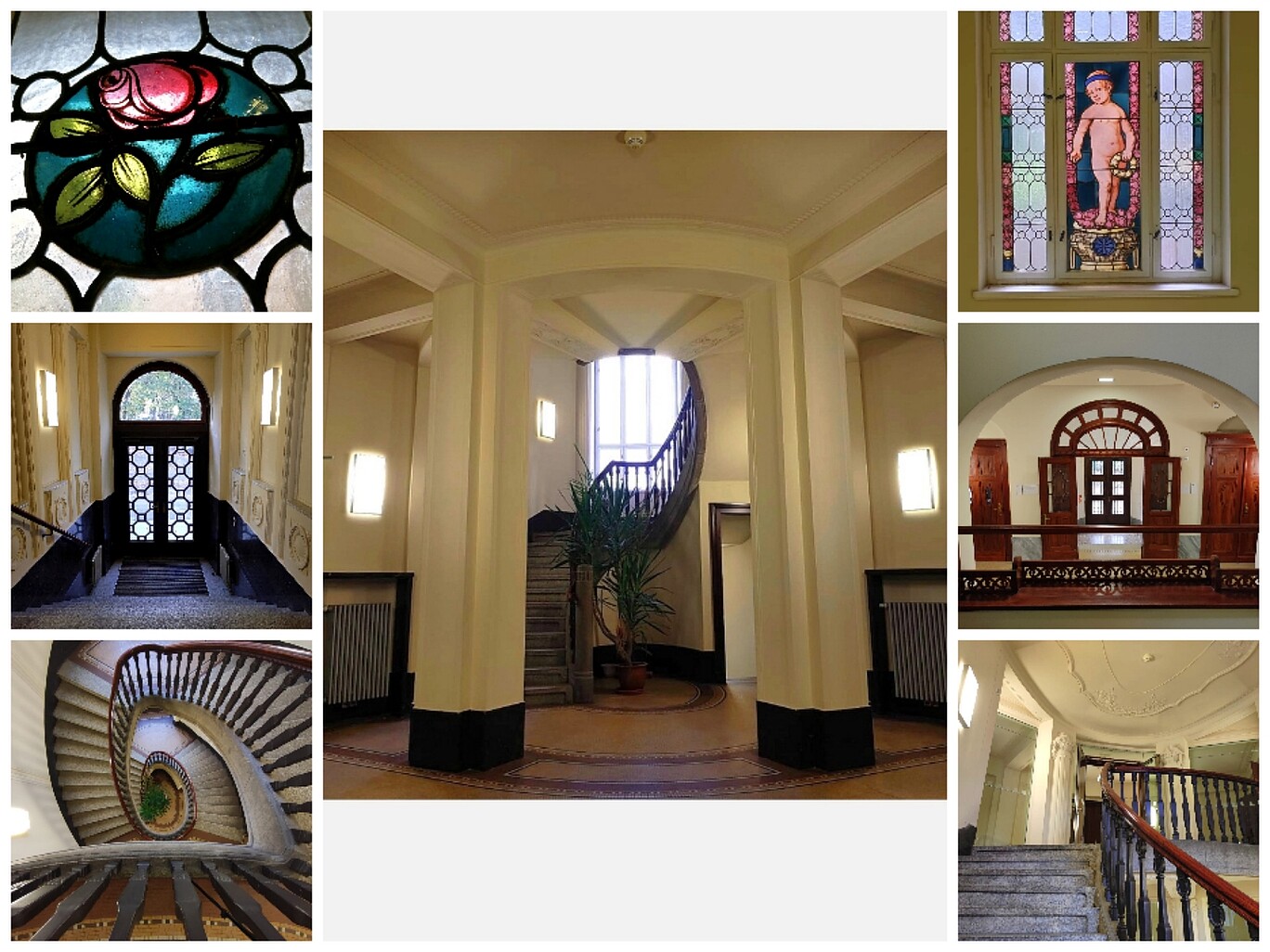
The western part of the building follows a villa-like interior structure. The centerpiece is the staircase with an elliptical staircase. Wooden decorations on the doors and banisters, column reliefs and stucco decorations are lifted into the modern age by glass doors on the way to the seminar rooms. The smaller lecture hall, which is located in the checkerboard-tiled basement, can be reached via a spiral staircase.
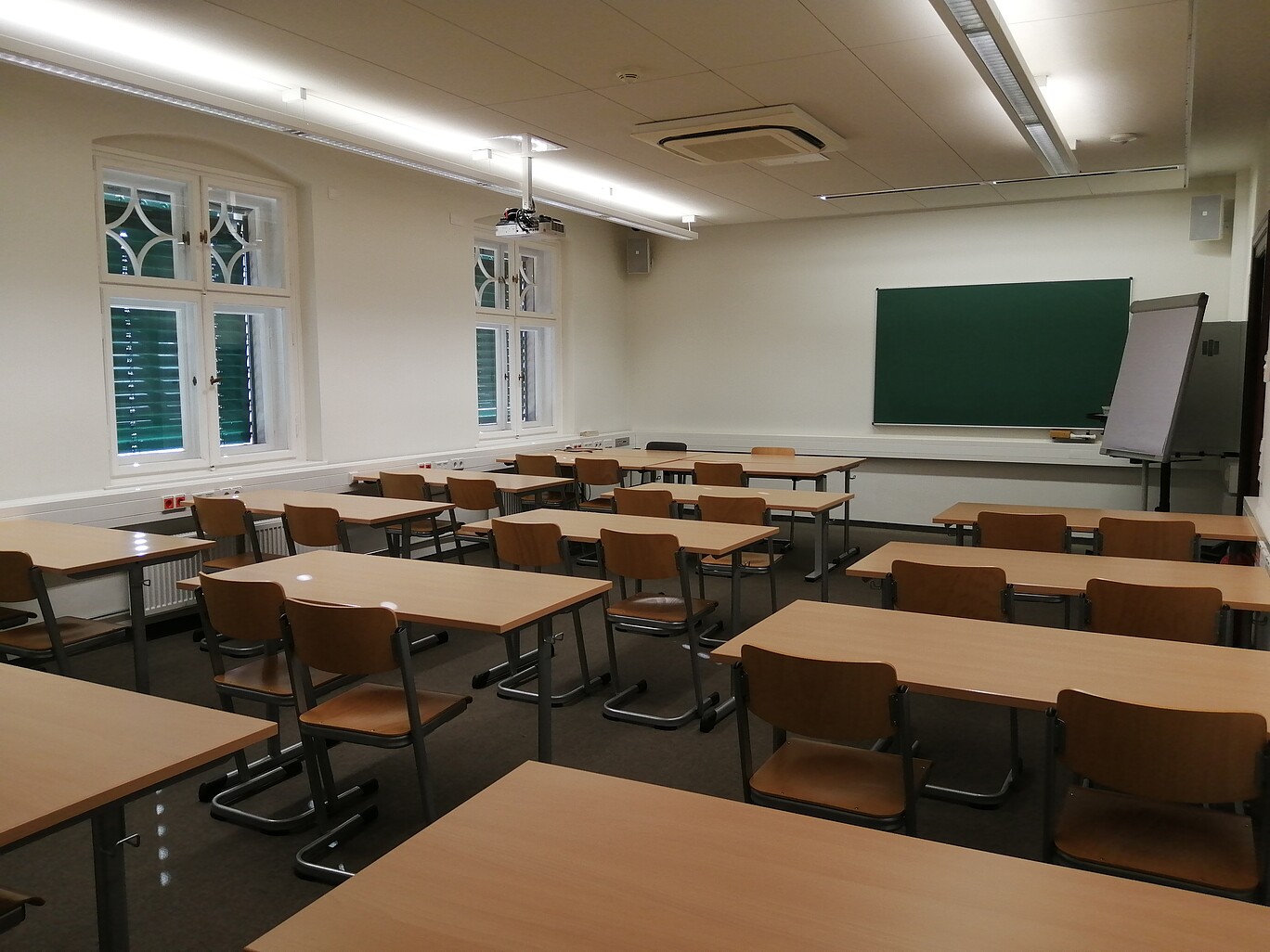
The part of the building on Brückenstraße gives the impression of being taught privately in a manor house. My personal favorite seminar room (room 307) is on the top floor. The low ceiling and ornate window frames lend the room a certain coziness.
The eastern part of the teaching building is reminiscent of a public institution, like the headquarters of an insurance company. The coat of arms of the "Rothenburgische", which formerly identified the building as a trading house, can still be seen above an entrance.
The building has a rectangular inner courtyard. There are several entrances, each of which opens up a completely different perspective of the premises as you enter. As a newcomer to our faculty, it's easy to get lost. But after a while you get the hang of it.
Around every corner, you can discover variations on the style of the entire building complex: sweeping marble-look staircases, smaller ones in fine wood, unusual window paintings, wood paneling and doors. Instead of a long corridor with rooms branching off, as in the western part, the building has a kind of vestibule leading to offices and conference rooms. This is followed by corridors that lead around the inner courtyard and form a corridor to some of the seminar rooms.
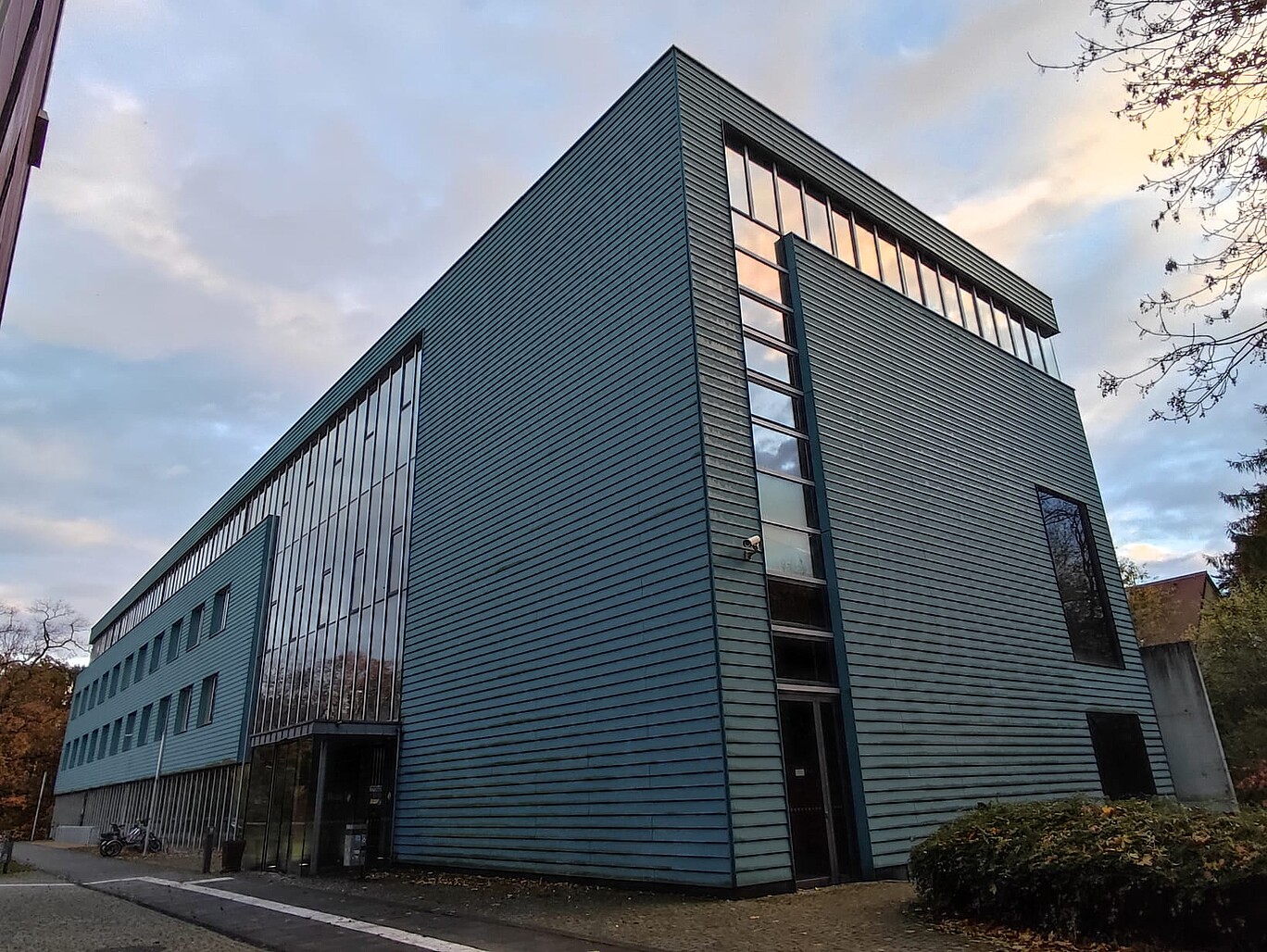
The campus in Görlitz also offers just the right thing for all practically-minded students in our faculty who are not interested in playful ornamentation: teaching in Building G I.
Due to a lack of space, the building application for the G I teaching building was submitted in 1995 in order to be able to continue research and teaching in a sophisticated manner. Two years later, an architectural competition was held to design the future "Hermann-Heitkamp-Haus". At the same time, the old factory building, where the G I now stands, was demolished. Construction work was completed in 2001. Today, students, including those from our MK faculty, come and go here to admire the modern teaching building.
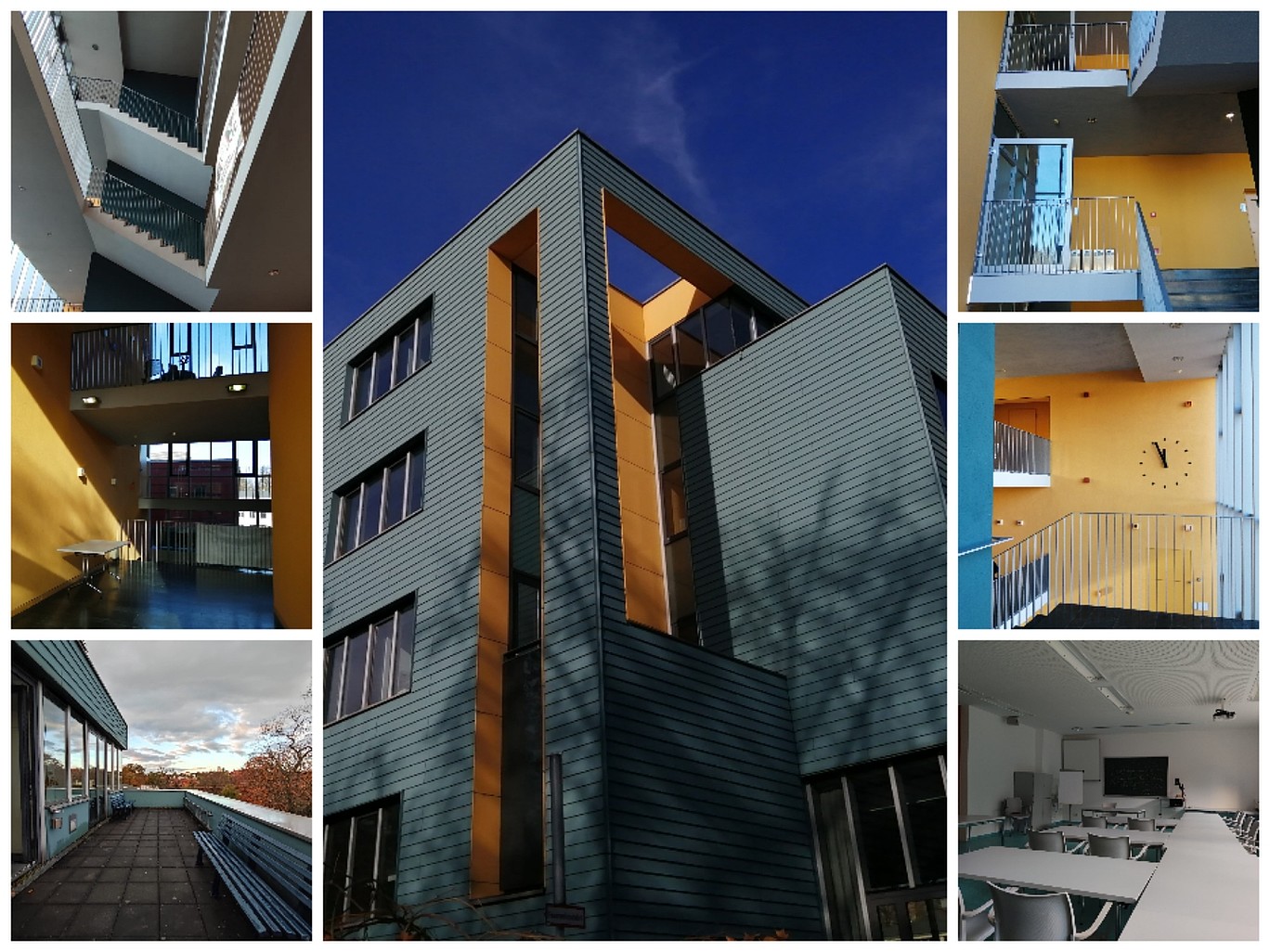
The guiding principle behind the design by Munich architects Ingrid Burgstaller and Michael Gebhard was to create a teaching building with a clear university character. I think they did a very good job. The elongated building stands out with its cool blue façade. However, the progressive appearance is created by the division into openings and incisions, partly supported by color and texture changes in the material and by long window fronts. This unconventional, futuristic design creates the atmosphere of a place of research, education and progress.
Inside the teaching building, an open staircase hall in orange creates a warm impression. Two lecture theatres are located in the western part, the floors are partially exposed in the form of balconies. There are two open-air terraces on the top floor - the larger one in the east offers a wonderful view over the banks of the Neisse. With their design, the architects wanted to highlight the connection to the neighboring country of Poland. To this end, the structure of the teaching building was designed to face the Neisse: to the east of the staircase hall, the corridors run directly towards the national border.
The seminar rooms offer space for many students and are equipped with the latest technology.
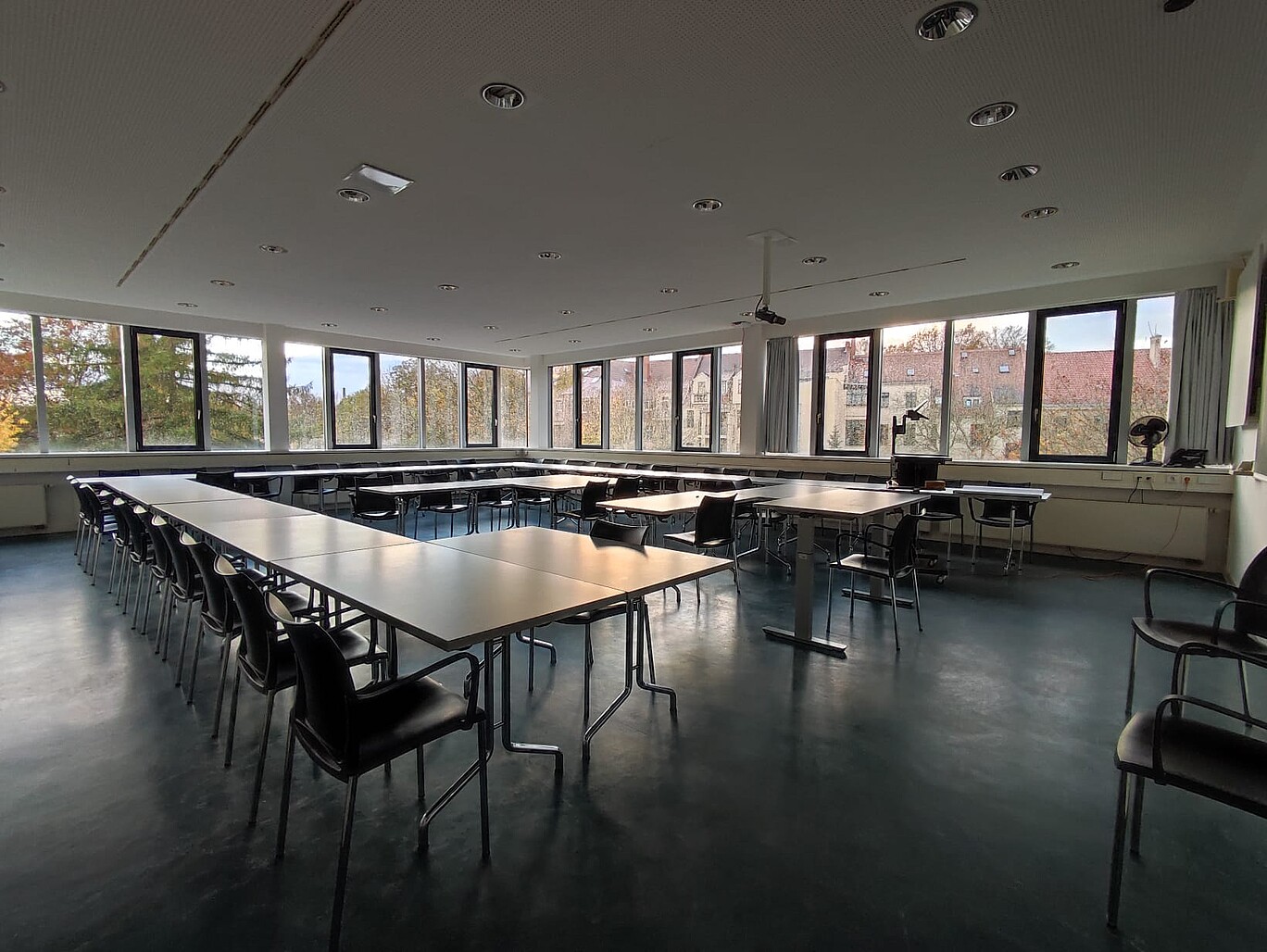
My favorite room (room 3.02) in this building is again on the top floor. This large room has a long window front on two sides with a view of the campus and the roofs of the surrounding residential buildings. If you're lucky, you might even see a cat walking along a gutter from there.
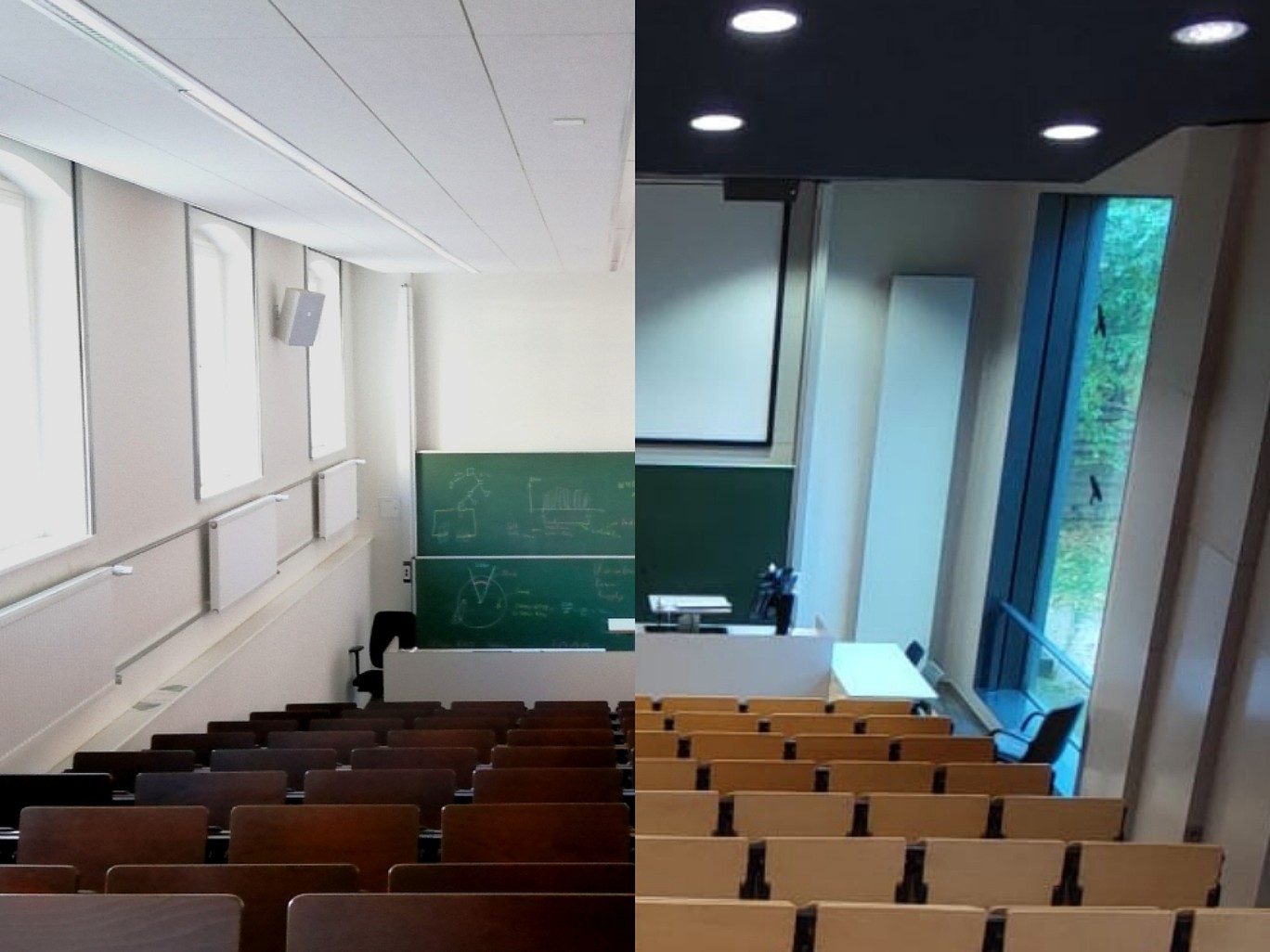
Personally, even after a year, the G II teaching building still enchants me every time I step through the front door. I keep discovering new details in the design that make the learning atmosphere so special: You could almost imagine you were enrolled at one of the traditional American universities.
The G I teaching building, on the other hand, allows us students of the MK faculty to see our future: learning in the futuristic, formal building feels like you are already in an influential position as a manager of a company.
As I am passionate about both styles, I appreciate the variety that F-MK offers me as a student. If you also think that the combination of historical and futuristic atmosphere offers the perfect ambience for studying, then take a look at the courses offered by our faculty.