Strong signal to young people in Upper Lusatia: innovative university projects receive millions in funding.
The Zittau/Görlitz University of Applied Sciences is receiving impressive financial support for innovative STEM education projects. Upper Lusatian MP Franziska Schubert (Alliance 90/The Greens) was able to secure five million euros for projects to strengthen the next generation of STEM specialists. The funds made available for this purpose come from the assets of political parties and mass organizations of the GDR (so-called PMO funds). A federal guideline regulates how they are to be used. In future, the funds could be used to implement innovative approaches to extracurricular education from the "Future Learning Location Upper Lusatia (ZuKLOS)" project, among other things.
Franziska Schubert, Chairwoman and Upper Lusatian member of the Alliance 90/The Greens parliamentary group in the Saxon state parliament, is delighted with this success for the region:
The Zittau/Görlitz University of Applied Sciences plays a very important role in the region, especially with regard to the challenges of structural change. We need prospects for young people and the university offers a great range of opportunities. I have been following its development for quite some time now and I like the fact that the university locations are being developed with fresh energy and passion. With the project 'Zukunftslernort Oberlausitz', the HSZG is proving this once again. The project has supra-regional appeal and will be accessible to all young people in Upper Lusatia with central and decentralized locations. The aim is to create extracurricular places of learning that, among other things, prepare young people for working life. Companies in the region will also benefit from this."
”The "ZuKLOS" project aims to secure the next generation of skilled workers in Upper Lusatia, particularly in the STEM professions. Strengthening school-based, formal education and extracurricular, non-formal education is particularly important for this. Unlike school education, extracurricular education does not have to fulfill any "officially" prescribed curricula or quality guidelines. With this in mind, ZuKLOS will investigate how the future technologies identified for Upper Lusatia in terms of economic policy can be taken up by the providers of extracurricular learning and offered in a curricular manner. In addition, the so-called soft factors (spaces, access, co-determination, specifications versus self-exploration) and their influence will be analyzed. Rector Prof. Dr. Alexander Kratzsch sees great potential in this approach:
We want to increase interest in STEM subjects among young people in our region. Children's innate curiosity often goes hand in hand with a great thirst for knowledge. We want to maintain and encourage this thirst for knowledge, especially for future-oriented topics. To this end, we are focusing on extracurricular activities that will help us to train a large number of well-qualified and highly motivated specialists for the challenges of our time and for our region."
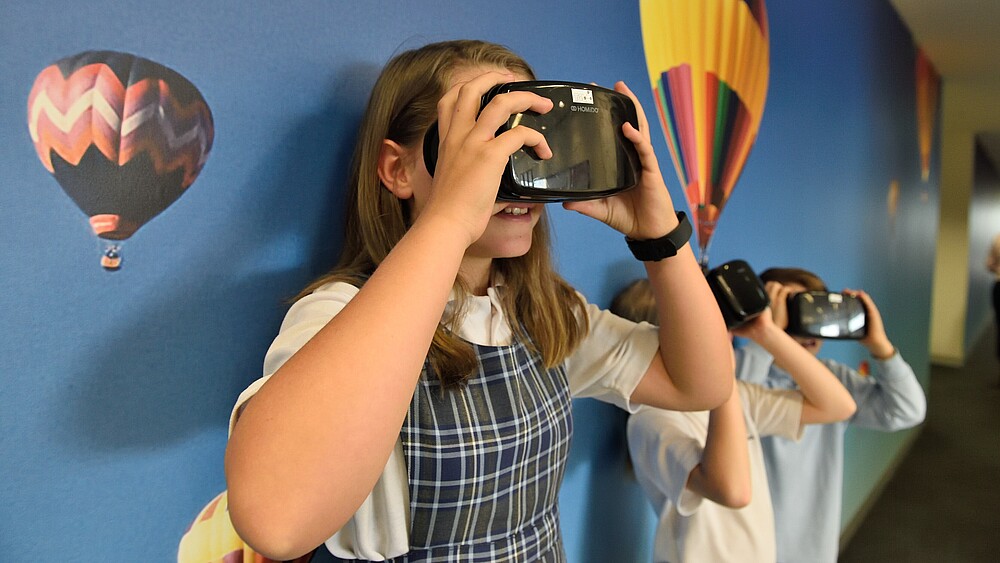
”To achieve this, experts from education, science and business will look at the future technologies of this region, such as virtual reality, augmented reality, lightweight plastic construction, energy and mobility . In a joint discourse, proposals for extracurricular offers will be developed, which will be summarized into so-called future topics of extracurricular education. The fact is that young people's points of contact with new technologies are still inadequate. Extracurricular education in Upper Lusatia is addressing this issue and will communicate corresponding recommendations for action at a transfer conference at the end of the project. This is expected to boost the quality of the individual extracurricular learning locations , both existing and newly established. The cities of Görlitz and Zittau, as well as the Zittau/Görlitz University of Applied Sciences, intend to establish further learning locations following the project and by 2030. Furthermore, competence-balancing instruments (potential diagnostics) will be used and their influence on the self-determination and motivation of the target group will be determined.
The project can be seen as an initial project in which research will initially be conducted into the current status of extracurricular education in the districts of Görlitz and Bautzen during the one-year project period. The project partner is the TU Dresden.
The ZuKLOS project is part of the Lausitz - Life & Technology alliance, which is funded by the (BMBF) program "WIR! - Change through innovation in the region" program.