
27. October 2016
4th ZINT Workshop at the HSZG
The focus was on the topic of how school inclusion of pupils with disabilities can succeed.
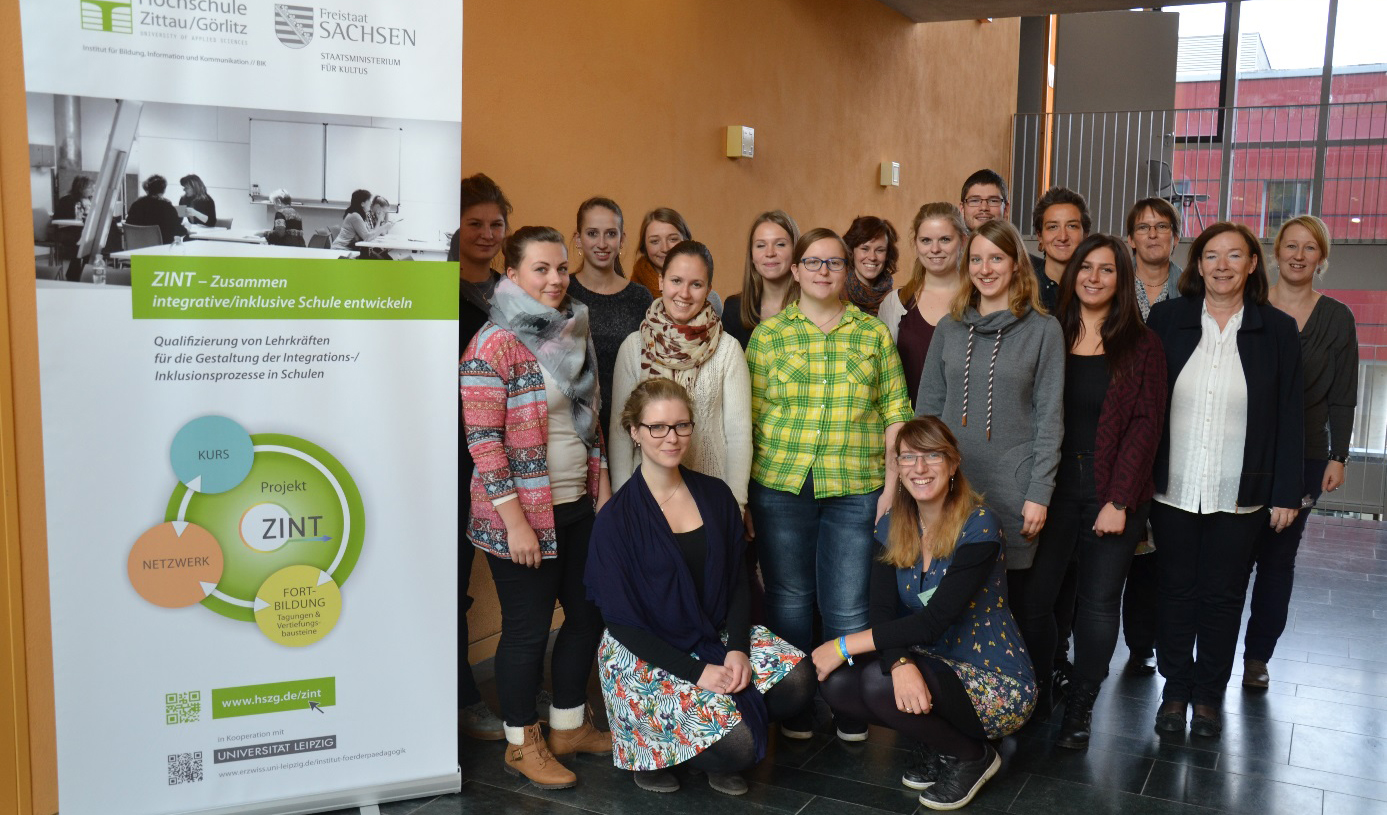
As part of the project “ZINT—Developing an Integrative/Inclusive School Together,” a workshop titled “Those Who Learn with a Smile Learn to Love Life” took place from October 20 to 22, 2016, at the Zittau/Görlitz University of Applied Sciences . They engaged in in-depth professional discussions with integration consultants, school supervision staff, those responsible for the integration of students with disabilities in mainstream schools, and special needs education teachers regarding the design of inclusive teaching and school development. We welcomed approximately 150 participants from all over Saxony, as well as 30 speakers from across Germany and Austria, to the conference.
The event was moderated in their usual professional manner by Mr. Jörg Heidig and Mr. Fabian Starosta of KIB e. V., who presented a comprehensive overview of the issues and challenges involved in designing instruction for integrative/inclusive learning groups.
Prof. Dr. Friedrich Albrecht, as Rector of the Zittau/Görlitz University of Applied Sciences and project director of the overall project, welcomed the participants and focused his opening remarks on the development of the ZINT project from 2008 to the present. In addition to the further development of the project’s concept, the focus was particularly on expanding the project through the development of networking activities and in-depth professional development opportunities, including the annual workshops. Ms. Petra Zeller delivered the welcoming remarks on behalf of the Saxon State Ministry of Culture, which has supported the project’s content development since its launch in 2008 and serves as a funding partner. Dr. Peter Jogschies conveyed greetings from the Prorector for Education and International Affairs at the University of Leipzig, as well as from the Institute for Special Education, as a representative of the project partner.
The opening presentations on the first day of the conference were given by Prof. Dr. Erwin Breitenbach of Humboldt University of Berlin, addressing the question “Inclusive Diagnostics? The Necessity of Diagnostic Skills in Inclusive Education and Diagnostic Tasks for Teachers.”
Jörg Heidig, a certified communication psychologist and organizational and process psychologist, addressed the question: “Meeting the demands of individualized support through multiprofessional expertise and cooperation—or how can multiprofessional cooperation among teachers from different types of schools contribute to individualized support?”
The second series of presentations addressed two fascinating topics.
Dr. Barbara Schratz from the Institute for Teacher Education and School Research, Center for Learning Schools at the School of Education, University of Innsbruck, Austria, focused her remarks in particular on the issue of well-being for teachers and students as a decisive factor for learning and academic success. Her presentation was titled “Resilience, Inclusion, and the Joy of Teaching and Learning.”
Jana Thiele and Dr. Angelika Wolters presented materials, approaches, and challenges in the development of good school practices. Under the premise that “many strong ‘I’s’ lead to a vibrant ‘we,’” they outlined the factors for successful school and classroom development and, using specific factors as examples, presented possible paths to successful school development. To this end, they invited the participants to take part in a sample field trip.
Prof. Dr. Birgit Werner from the Heidelberg University of Education invited participants on Friday to reflect on the question: Is inclusive instruction also good instruction? She explored inclusive instruction within the tension between educational standards and individual competencies.
And Dr. Sven Basendowski enriched the discussion with an international perspective: young people in challenging life situations navigating the transition between school and vocational training in Switzerland, Finland, and the United States.
Workshops and sessions designed to support students with special needs education—both from the perspective of those directly affected and the professional perspective, as well as opportunities for cooperation and respectful collaboration with special needs education teachers at special education schools and support centers in Saxony, rounded out the program with professional insights into the development of inclusive schools and instruction. The Institute for Special Education at the University of Leipzig was actively involved in the workshops across all its departments.
The event concluded with comedian Peter Schulze, who interpreted the topic from the perspective of a “gelontologist” and gave the participants’ laugh muscles one last good workout to wrap things up. Thus, the participants left the 4th Workshop feeling reenergized and equipped with many professional insights and personal impressions.
On behalf of the Leipzig Association for People with Disabilities e. V., Gunter Jähnig presented the fantastic, self-developed didactic and methodological learning and play materials on the topic of “Learning Accessibility Through Play,” and the Comenius Bookstore in Görlitz invited participants to a literature table to browse and take home relevant specialized literature on the topic.
The first day of the conference came to a wonderful close in the evening at VINO E Cultura with a “Meet and Talk” event, offering the opportunity to exchange ideas, make new connections, and strengthen existing ones—thanks in part to the entire restaurant team led by Ms. Simone Apitz. The mentalists Thomas Majka and Vincent Frommer invited us to their witty and charming thought experiment and left both teachers and scientists in awe. The thought that lingered even at the end of the conference—“How on earth do they do that?”—will certainly help ensure that we’ll see some of the participants again at the upcoming conference in October 2017.
Our thanks go to all those who supported the conference: Sandro Hänseroth for the conference documentation, Jürgen Möldner for technical support, and the students at the University for their assistance with conference organization.
Thanks also go to the custodians Mr. Otto, Mr. Zucker, and Mr. Zenker, as well as Ms. Krusch from the Academic Administration Office for their support in organizing the conference. The Kelichhaus catering and restaurant service in Görlitz once again succeeded in delighting the conference participants with its culinary offerings.
During the conference, dedicated educators from all types of schools were able to deepen their subject knowledge, share experiences, and expand their own skills with the goal of jointly finding ideas and solutions to overcome challenges on the path to inclusive school development.
We would like to thank the Zittau/Görlitz University of Applied Sciences for its support of the conference and look forward to the 5th conference in fall 2017, which will feature new topics on integrative/inclusive teaching and school development.
Your Contact Person
"Project ZINT: Developing an Integrative/Inclusive School Together"
Institute for Education, Information, and Communication
Zittau/Görlitz University of Applied Sciences
Dr. Petra Koinzer
Phone: 03581/374 4258
Email: p.koinzer(at)hszg.de