

07. September 2016
Erasmus+ worldwide
Partners from Kostroma, Russian Federation, Visit Zittau/Görlitz University of Applied Sciences
The application criteria for the “Erasmus+ Worldwide” program are rigorous, and the time required to submit an application is considerable. We were therefore all the more delighted when the funding approval arrived a few weeks ago:
The DAAD’s national agency awarded the HSZG approximately 80,000 euros to fund future faculty and student mobility programs in Russia and Kazakhstan, covering a total of 25 mobility projects through 2018.
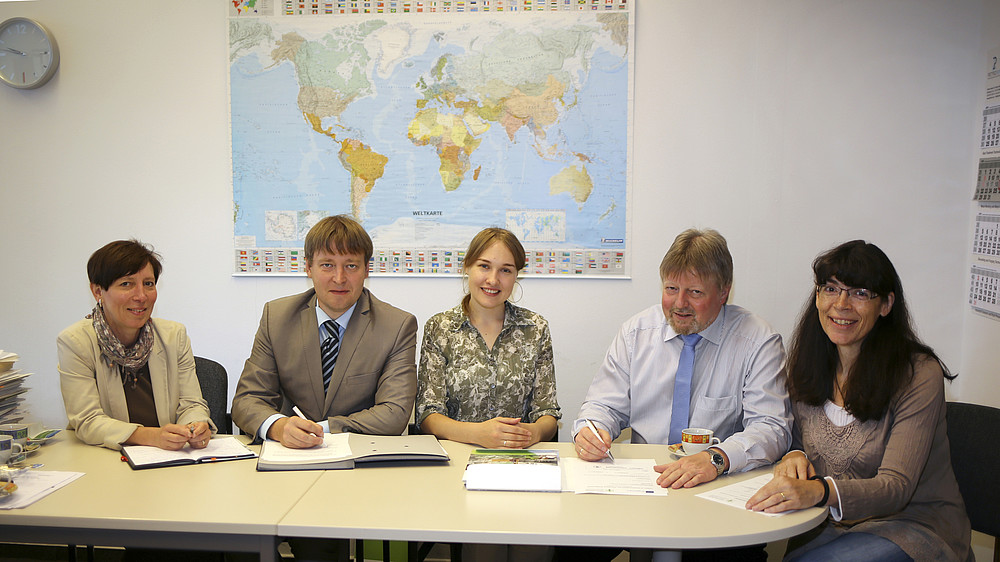
Thanks to Erasmus+ Worldwide, the university was now able to welcome its first guests from Kostroma State University. After a tour of the campus, Prof. Denisov, a professor of integrated management, and Ms. Rassmagina from the International Office of the partner university were impressed by the university’s higher education institutions. The current discussions with Prof. Jana Brauweiler focused primarily on expanding the dual-degree program in the field of integrated management, which was established between the two universities in September 2014, under which, starting in the 2017–2018 academic year, the first students are scheduled to complete one or two semesters of study abroad at our university. A German student is scheduled to spend the summer semester of 2017 in Kostroma as part of her master’s program. Thanks to the active support of Nikita Kozychev, a Kazakh student in the “integrated management” program at our university, and Frank Schneider, Studium Fundamentale, a successful social program was organized for the guests, including, among other things, a city tour of Zittau, a hike up the Oybin followed by dinner in the Czech Republic, and a visit to Dresden.
Applications under the European Union’s Erasmus+ program can be submitted annually and independently of subject areas and, with a few exceptions and budget constraints, are still possible through 2020 (the end of the Erasmus+ program). The central goal with regard to student mobility is the mutual recognition of academic credits earned at the respective partner universities.
ERASMUS+ is the European Union’s action program for cross-border cooperation in Europe for the period 2014–2020. It consolidates the previous programs for lifelong learning, youth, and sports, as well as programs for higher education. In Germany, the program is coordinated by the National Agency for EU Higher Education Cooperation within the DAAD.
Faculty of Natural and Environmental Sciences
02763 Zittau
Külzufer 2
Building Z VI,
Room 07
First floor
First floor
+49 3583 612-4752