
23. March 2016
22nd International Electrical Engineering Olympiad
49 students from Germany, Poland and the Czech Republic compared their knowledge in the field of electrical engineering.
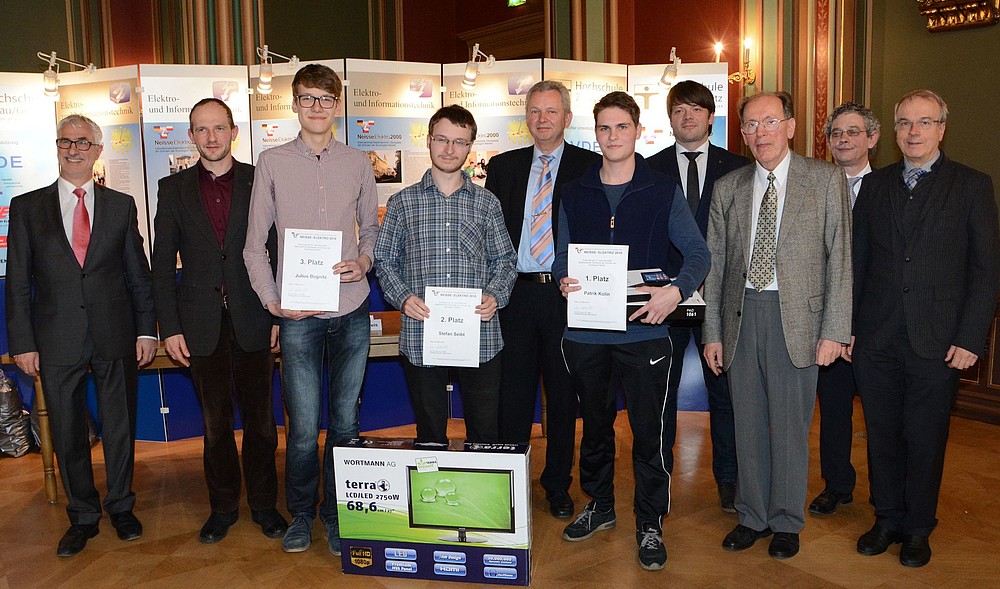
On March 19, 2016, the final round and awards ceremony of the 22nd Neisse-Elektro International Electrical Engineering Olympiad were held at the Zittau/Görlitz University of Applied Sciences. The event was held under the patronage of the Saxon State Minister for Science and the Arts, Dr. Eva-Maria Stange.
In the historic Bürgersaal of Zittau City Hall, the rector, Prof. Dr. Friedrich Albrecht, warmly welcomed those in attendance, including Dr. Stephan Meyer, a member of the Saxon State Parliament; Mr. Hermann Jaeckel, representing the State Minister; the Mayor of Zittau, Mr. Thomas Zenker; and Prof. Dr.-Ing. habil. Herbert Kindler from the VDE Dresden Regional Association e.V. (main sponsor), Prof. Dr.-Ing. habil. Herbert Kindler, as well as representatives from the Turow Power Plant (PL), the schools in Varnsdorf, Görlitz, Löbau, Zittau, Bautzen, Liberec (CZ), Dĕčín (CZ), Bogatynia (PL), Jelenia Góra (PL), and Bolesławiec (PL).
He explained that over the past 22 years, the International Electrical Engineering Olympiad has become a fixture in cross-border cooperation at our university and in the Neisse Euroregion. “This includes not only the diverse contacts within the ‘Neisse-Elektro’ working group, but also, above all, the dedicated teachers, university professors, and organizers in the Czech Republic, Germany, and Poland. They have accompanied the participants all the way to the finals and, above all, motivated them to take part in this competition. They are all united by a common goal: to inspire young people to pursue higher education, especially in engineering and natural sciences,” the rector continued.
Hermann Jaekel, head of the Department of Universities of Applied Sciences at the Ministry, conveyed greetings from Saxony’s Minister of State for Science and the Arts, Dr. Eva-Maria Stange. Quote from the Minister of State’s welcoming remarks: “The 22nd International Electronics Olympiad is a wonderful example of European cooperation. Today, more than ever, anyone who wants to discover something new must be open to the world and cross borders. Science and research have always had an international focus. When you, dear participants, came together to prepare for this Olympiad and now during the final round of the competition here in the “Three-Country Triangle,” you have not only experienced and applied electrical engineering at the highest level, but at the same time realized just how important this cross-border collaboration is. This borderless exchange not only provides technical insights but also enriches our shared lives and fosters new friendships; it opens paths to your own successful future and to the future of our three countries. So, in a sense, you are all already winners in terms of knowledge, European culture, teamwork, language, tolerance, and more. What matters most for each of you is that you rose to the challenges of this Olympiad and actively participated in the competition of ideas. I congratulate you all on this and wish you all the good for your future.”
This year, 49 students from Germany, Poland, and the Czech Republic compared their knowledge of electrical engineering in the finals. Between the final round and the awards ceremony, the students went on an excursion to the Zittau City Baths, the oldest historic public bathhouse in Germany. There, they were given a tour and learned about the history and renovation of the Building.
At the subsequent awards ceremony for the team competition, the Czech team once again took first place, followed by the German and Polish teams.
In the individual competition, Patrik Kolín from Liberec (CZ) won the International Electrical Engineering Olympiad. He took first place by a wide margin and received a tablet PC with a detachable keyboard as a prize. The runner-up, Stefan Seibt, is from the Vocational Training Center in Zittau. He also received a tablet as a prize. Also from Germany is the third-place finisher, Julius Bognitz, from the Joliot-Curie High School in Görlitz. He received a flat-screen monitor as a prize.