
22. December 2016
New medical technology laboratory in Görlitz
The communication psychology degree programme uses the new laboratory to measure human performance parameters.
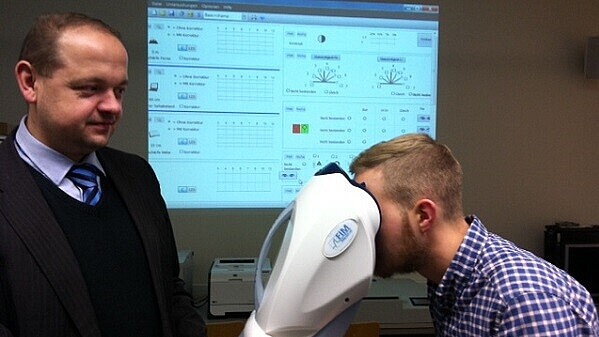
On December 9, 2016, the Medical Technology Laboratory in Görlitz presented its teaching materials and research projects for the first time to representatives of the Saxon State Medical Association in the Görlitz district.
The communication psychology degree programme uses the laboratory to measure human performance parameters for applied research and teaching. In the Master's degree programme in Social Gerontology, these measurement methods are used to assess physical and cognitive vitality parameters associated with aging. The “Corporal Plus” psychometric test is also used for driver fitness assessments and during medical-psychological examinations (MPU), along with a hearing test (audiometer) and the Vistec Visiolite vision testing device.
Visitors showed particular interest in the presentation by Diplom Psych. Tino Schmidt, who introduced current medical technology applications.
For example, in collaboration with Dresden University Hospital, a computer-assisted learning therapy for the most common mental disorder in children and adolescents (ADHD) is being developed for home use. It is based on mobile measurement of brain waves in the patients’ natural everyday environment.
However, the focus of this new research approach is on preventing illnesses long before they occur; according to a study commissioned by the federal government, everyday stress in the workplace is the primary long-term cause of chronic illnesses. 82 percent of the 17,000 respondents reported having at least one health problem due to workplace stress (Federal Stress Report 2012).
At the same time, the rate of sick leave is disproportionately high in the very sectors with the greatest growth potential—namely, elder care and the future jobs of Industry 4.0 (DGB, 2016).
To address this problem, new technological methods are being developed in cooperation with the Brandenburg University of Technology Cottbus (Institute for Medical Technology/Medical Informatics), new technological methods are being developed—such as miniaturized long-term self-monitoring ECGs (electrocardiography for examining heart activity) and low-energy CPR measurement circuits—that can continuously record users’ vital signs over several months —in order to use highly sensitive measurement methods to detect risks in a timely manner that would otherwise develop into diseases only over the course of several years.
This approach breaks new ground, as the psychological stress and strain measurement methods commonly used to date have relied on subjective questionnaires and interviews. The laboratory is therefore supervised by occupational and organizational psychologist Prof. Dr. rer. nat. Matthias Schmidt.

Faculty of Social Sciences
02826 Görlitz
Brückenstraße 1
Building II,
Room 156
First floor
First floor
+49 3581 374-4315