
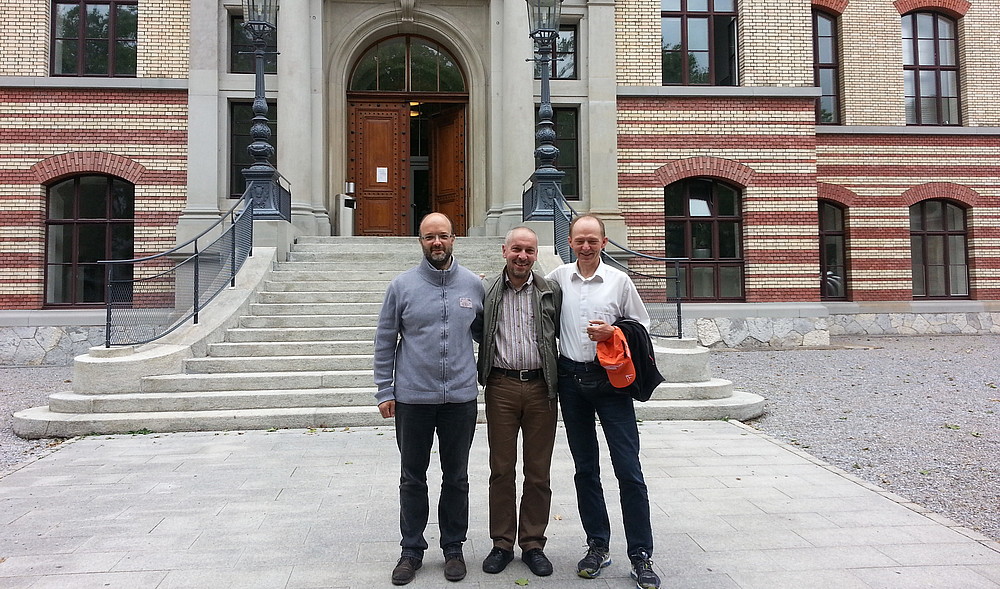
Prof. Schulze from the Faculty of Electrical Engineering and Computer Science was a guest at the Swiss Federal Institute of Technology Zurich (ETH) in June 2015. He was invited by the Department of Computer Science to give a lecture on the topic of “Computer Science Pedagogy.”
His lecture, titled “Output Orientation Among Beginner Programmers—Challenges and Consequences,” addresses the observation that students in STEM subjects are increasingly having difficulty understanding mathematical expressions and translating them into a programming language or a spreadsheet. Consequently, they are not sufficiently prepared for the development of transfer skills.
The ACM/IEEE-CS (Association for Computing Machinery/IEEE Computer Society) and the GI (German Informatics Society) have issued a comprehensive set of recommendations regarding the necessary computer science competencies. Since competencies are latent characteristics that cannot be directly observed or measured, usable indicators are needed. Tasks are good at fulfilling this requirement if they are objective, reliably observable and measurable, and, furthermore, valid in relation to the competency being measured. Neither ACM/IEEE-CS nor the GI specify concrete tasks. It is therefore up to each instructor to select tasks from textbooks or to create them.
Using the example of transferring mathematical expressions in the training of beginner programmers, Prof. Schulze demonstrated how the gap between competencies and tasks can be bridged through specific task types. The result is a collection of exercises and descriptions of exercise types that are reminiscent of the famous Russian and American exercise collections and, due to their design, are almost universally suitable for computer-based assessment.
At ETH Zurich, Prof. Schulze’s lecture was regarded as paving the way for future collaboration with Zittau/Görlitz University of Applied Sciences in the field of subject-specific didactics. He will therefore return to Switzerland in October to further strengthen this cooperation with another specialized lecture.
Contact:
Prof. Dr. rer. nat. Jörg Schulze
 , Faculty of Electrical Engineering and Computer Science
Email: joerg.schulze@hszg.de