
13. April 2015
21st final round of the "Neisse-Elektro" Olympiad
Exciting scientific competitions among high school graduates and self-driving robots in Zittau.
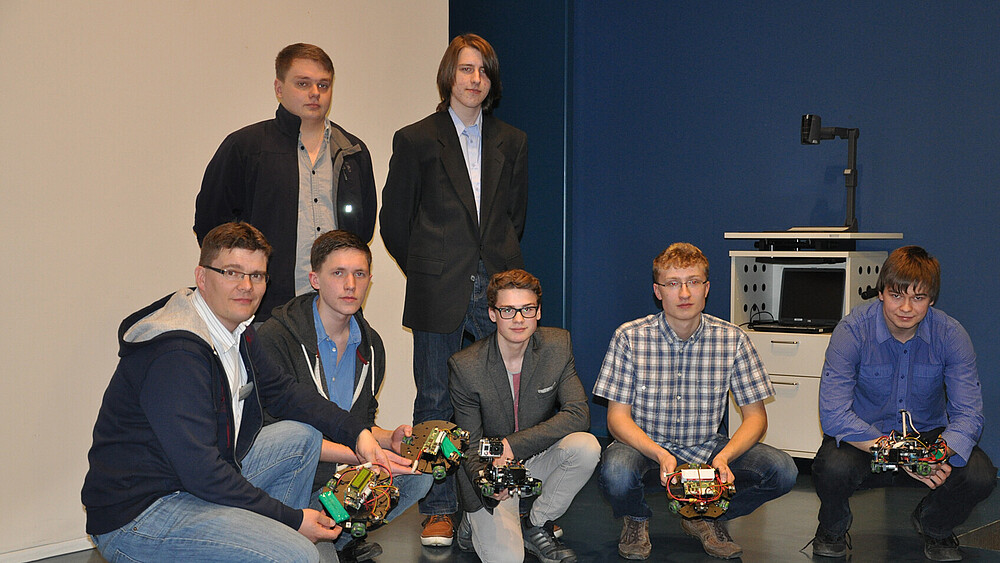
"I can hear your hearts pounding all the way from here," said Prof. Dietmar Scharf of the Zittau/Görlitz University of Applied Sciences as he welcomed nearly 50 students last weekend. The students from the Czech Republic, Poland, and Germany participated in the 21st International Electrical Engineering Olympiad “Neisse-Elektro.” Most of the students are about to take their high school graduation exams. Many will begin their college studies this fall. The Faculty of Electrical Engineering and Computer Science had organized the final competition. For 90 minutes, the students pondered, calculated, and solved challenging problems in the field of electrical engineering. While the teachers graded the invigilated (written) examination, the groups of students enjoyed the exciting supporting program, which included a demonstration of self-driving robots.
Various schools from the district (BSZ Zittau, Löbau, and Bautzen; Löbau High School) competed with their teams. Plate-sized robots equipped with distance sensors, rechargeable batteries, a control unit, and three powered wheels were tasked with navigating a maze. It was thrilling for the spectators to watch the robots navigate the corridors using their sensors. Some robots moved purposefully forward, while others seemed to drive back and forth somewhat aimlessly. What may sound like just a bit of fun at first can, however, be the start of a productive and educational pursuit for the students.
In our everyday lives, there are many devices that combine mechanics, electronics, software, and communication. Companies in the skilled trades and industry are looking for talented and enthusiastic people who work with an eye toward the future, take on responsibility, and blaze new trails within their companies. The university is happy to support these young people on their path by providing a good solid education.
Prof. Kästner then vividly demonstrated what chaos has to do with automation. His entertaining lecture made it clear that even systems functioning correctly can exhibit seemingly chaotic states. The graphical illustrations reveal interesting patterns, such as the fig tree diagram or the apple-bread man.
The awards ceremony in the town hall’s Bürgersaal was eagerly anticipated.
Which of the three countries would take the good spot? Had their preparation for the Olympiad paid off?
After a few words from the university’s rector, Prof. Friedrich Albrecht, and a welcoming address by the main sponsor, VDE Bezirksverein Dresden e.V. (represented at the awards ceremony by Prof. Herbert Kindler), the winners were announced.
The Czech Republic won the team competition.
The winners in the individual competition are:
1st place: Anton Lorenz from the Joliot-Curie-Gymnasium in Görlitz
2nd place: Maik Punke from the Christian-Weise-Gymnasium in Zittau and
3rd place: Vojtech Scholz from the Gymnasium Liberec in the Czech Republic.
The three winners plan to study physics, media informatics, and electrical engineering, respectively. The value of their school education became clear when asked about their preparation: All three stated that they were prepared for the Olympiad solely through their school classes. This should be seen as a compliment and a thank-you to the teachers who invest in the students’ education and are also deeply committed to the Neisse-Elektro competition.
The Zittau/Görlitz University of Applied Sciences and the Faculty of Electrical Engineering and Computer Science wish them every success on their upcoming high school graduation exams and much joy and success in their subsequent studies!