
"The border is not the edge, but the center of our cooperation"
The first Czech-German Erasmus+ Staff Week will take place from May 13-17. An interview with the initiators Lucie Koutkova and Stephanie Ludwig.
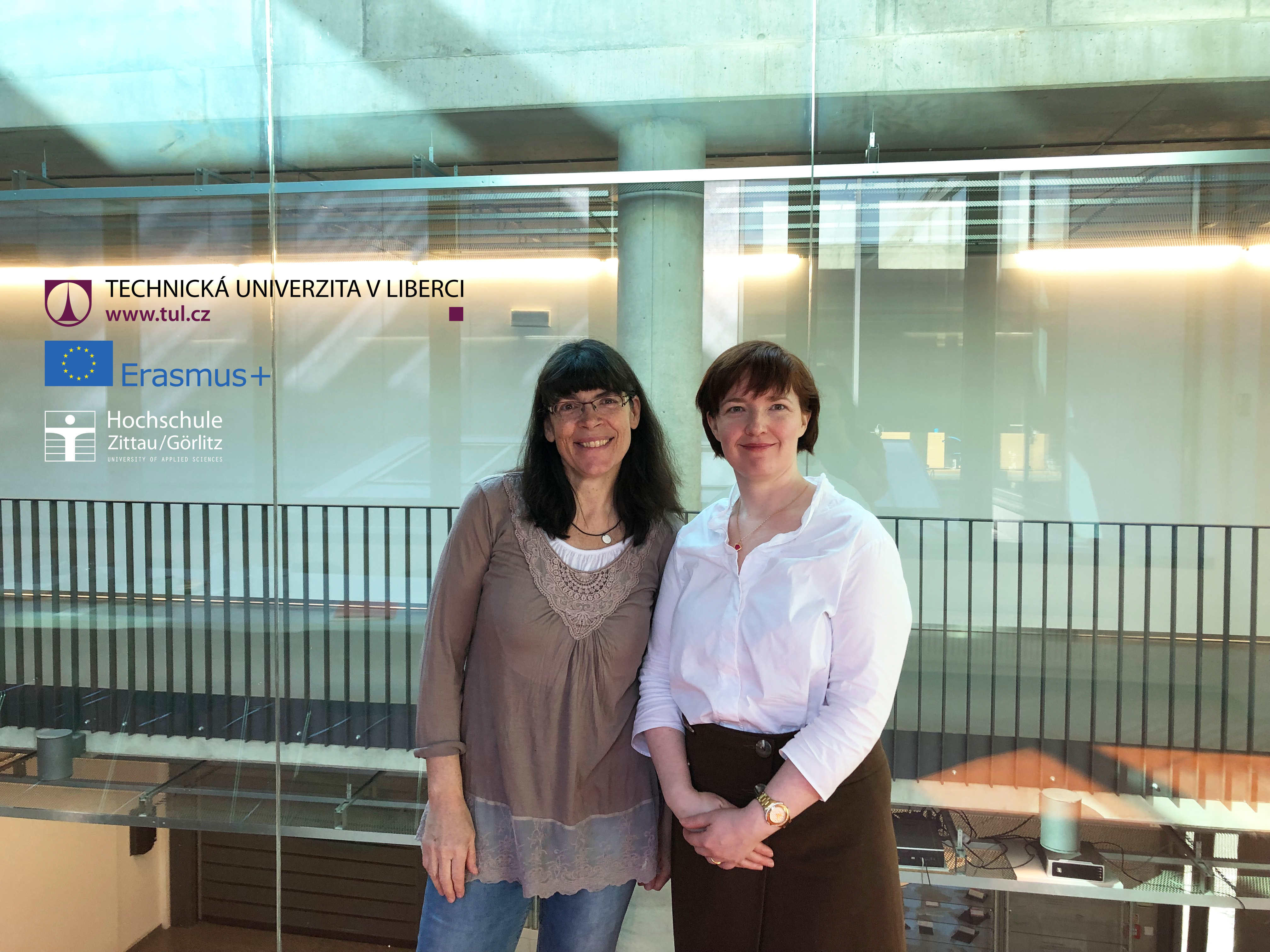
HSZG: Ms. Koutkova, Ms. Ludwig, you are jointly organizing an Erasmus+ International Staff Week at the Technical University of Liberec and the University of Applied Sciences Zittau/Görlitz. What exactly is this event about?
Stephanie Ludwig: Erasmus+ is Europe’s largest and most important mobility program. Its goal is to give students and university staff the opportunity to get to know universities in other countries and gain intercultural experiences. To this end, we collaborate with a large number of partner universities across Europe. This intercultural exchange seems particularly important to me in these times, when the European ideal is being viewed with a critical eye.
Lucie Koutkova: From my perspective, it’s very important that we organize Staff Week together. After all, this is actually the first cross-border Erasmus+ Staff Week to be organized by a Czech and a German university. Since the very idea of Erasmus+ is to shape an international higher education landscape, we’ve said for the first time: “Let’s do this now”—and we mean it literally.
HSZG: What does “Staff Week” mean?
Lucie Koutkova: The basic idea behind Erasmus+ is for students to do an internship or study abroad to gain new experiences. But people have also been looking for ways to make the same experiences accessible to staff members. And it was through this search for opportunities that the International Staff Weeks came about.
HSZG: So it’s basically an “Erasmus for staff”?
Lucie Koutkova: Exactly! Both faculty and non-faculty staff can participate. The basic idea is to invite your partners so they can get to know the institution. It’s also about solving problems and building relationships.
Stephanie Ludwig: Staff Weeks enable staff members from the International Offices—as well as those from other departments such as libraries, marketing departments, or 'Studentenwerke' (student unions)—to network and thus also have the opportunity to exchange ideas on an international level. This already happens daily in the International Offices. Other university departments are usually left out of such international exchanges. However, the overarching goal is to make the universities as a whole more international and to provide staff with greater opportunities for international and intercultural insights in the future.
“The border is not the edge, but the center of our collaboration”
HSZG: What makes the upcoming Staff Week special?
Stephanie Ludwig: We’re located near the border here: Who, if not us, could organize such an international event? Two universities, three countries, one Staff Week. For a future edition, it would also be conceivable for us to include other universities located near the border, such as our partners in Wrocław. This year, we’ll officially bid farewell to our guests during our closing dinner in Zgorzelec.
Lucie Koutkova: Universities usually position themselves within a national framework. The Technical University in Liberec compares itself to other universities in the Czech Republic and thus competes with the major universities in Prague or Brno. We’re not really in the center of the country, but rather on the periphery. That’s always an issue in Liberec. Through Staff Week, we’re turning this periphery—the border—into the center. Our region has great potential. We want to make more intensive use of this potential in the future.
What we’re doing here is a kind of shift in thinking. For me, this is a very important idea: the border is not the periphery, but the focal point of our collaboration. And the border becomes productive. This allows us to work together more effectively and achieve results on an entirely different level if we approach it the right way.
Stephanie Ludwig: We want to raise awareness. We want to show that there are good universities right here near the border that are positioning themselves internationally and offering interesting, high-quality degree programs.
HSZG: How will the week unfold in practical terms?
Stephanie Ludwig: We have various workshops planned, and we want to show participants the regions—namely Zittau, Görlitz, Liberec, and a small part of Poland. We want to network with the participants and, of course, learn from one another. We want to present ourselves as good hosts.
HSZG: What could both institutions learn from each other?
Lucie Koutkova: All universities currently have many partnerships. But of course, you can’t achieve the same level of quality with every partner. That’s why we look for strategic partnerships. I see the future collaboration between TU Liberec and HSZG as productive and strategic.
HSZG: What are your hopes for the upcoming Staff Week?
Stephanie Ludwig: We want to show the participants—who are coming not only from Europe but also from Asia and Africa—what’s possible here. We want to demonstrate that both TUL and HSZG are attractive universities with great potential. The essence of a Staff Week is always to present one’s own university in the best possible good light. That’s why it’s important to fill this week with life—with workshops, campus and lab tours, and an engaging social program. All these activities thrive on the collaboration of all university groups—students as well as staff members. This way, our guests experience that the spirit of internationalism isn’t just brought into the universities by the International Offices, but is essentially lived out by everyone.
The interview was conducted by Sophie Herwig.