
It all depends on the teacher with heart
On April 4, the opening of the exhibition of students' work took place at the Görlitz District Office. ZINT was there.
On April 4, an exhibition of student artwork from the Neisse Elementary School on the theme “The Joy of Having a Good Teacher” opened in the presence of representatives from the fields of education, politics, academia, and government.
Earlier on April 4, Bernd Lange, District Administrator of the Görlitz District, and Professor Dr. Friedrich Albrecht, Rector of the University of Applied Sciences Zittau/Görlitz, had signed the amended cooperation agreement between the district and the university at the Görlitz District Administration Office. Afterward, both took the opportunity to open the exhibition in the presence of Marlies Wiedmer-Hüchelheim, head of the School and Sports Office, as well as many visitors.
How lucky to have a good teacher…
… each of us has likely had this experience in school, and this statement can be viewed from various perspectives …
from the perspective of parents who want the good for their child,
from the perspective of the principal, who, together with the teachers at his or her school, wants to create a school where students enjoy learning and teachers enjoy teaching,
from the perspective of academia and politics, which place particular importance on high school graduation rates and a good education for everyone, or
from the perspective of the students themselves, who want a teacher who understands them and from whom they enjoy learning.
Time and again, it becomes clear just how important a good teacher is.
How fortunate it is to have a good teacher…
The exhibition showcasing the students’ exciting, astonishing, and diverse perspectives has been accompanying us in our work for the third year now and, after stops in Zwickau and the state parliament in Dresden, has now arrived at its third venue in Görlitz.
And the topic is just as relevant today as it was at the start of the collaboration between the ZINT project at Zittau/Görlitz University of Applied Sciences and the Astrid Lindgren School in Weißwasser and the Neiße Elementary School in Görlitz.
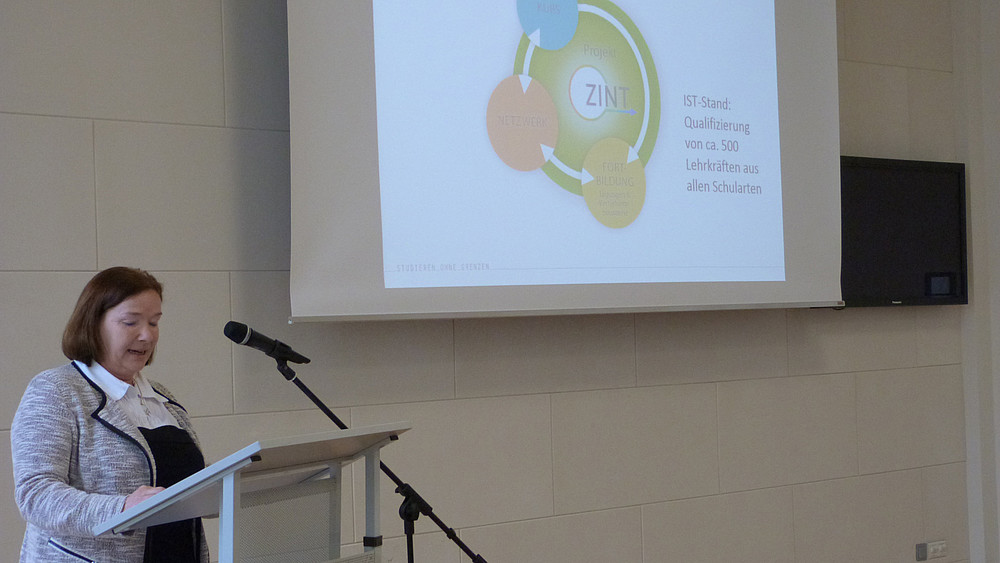
ZINT means “Developing an Integrative/InclusiveSchoolTogether.” Only through close collaboration and mutual support is it possible to further develop schools in a way that successfully supports every child’s learning, regardless of where they learn.
In 2007, the idea arose to train teachers from all types of schools to meet the challenge of integrating students with special needs education into general education—this was even before the Federal Republic of Germany signed the United Nations Convention on the Rights of Persons with Disabilities.
Since 2008, approximately 500 teachers from elementary schools, secondary schools, high schools, and vocational schools have received continuing education on issues related to the inclusive education of students with and without disabilities.
Today, the project consists of three parts:
1. The course—in which teachers receive professional development over seven modules during their school breaks, covering topics such as inclusive education, support planning, individualized instruction, as well as collaboration and counseling.
The goal is to acquire fundamental teaching and support strategies for inclusive education as well as basic knowledge of special needs education, and to further develop individual competencies regarding integration and inclusion. In addition, they are expected to serve as advocates for integration at their schools—acting as advisors or points of contact—and to support integrative and inclusive school development.
2. Regional Networking
Good cooperative relationships among schools form the foundation for addressing new challenges in school development.
The goal is to further expand the proven collaboration in the region and to further develop collaboration within schools.
Taking into account the current staffing situation at the schools, the goal is also to distribute responsibility across multiple individuals through clear task and work structures, as well as by designating specific points of contact for various tasks, so that the upcoming tasks can be fulfilled as good as possible. In doing so, cooperation and networking between individual schools and school types should be strengthened, and collaboration with extracurricular institutions should be sought even more actively at the regional level
3. Professional development programs—which are needs-based and contribute to the systematic development of competencies in integrative/inclusive teaching and school development for integration advocates.
These programs address questions that arise in practical work and facilitate the exchange of experiences. In addition, they impart strategic skills for working in schools as well as subject-specific content on lesson and school design, taking into account the heterogeneity and diversity of the student body.
A particularly popular component of the ZINT project is the annual workshops, which have been held since 2013 and focus specifically on mutual exchange as well as a rotating range of topics related to lesson planning, learning, and collaboration. The conference addresses the wide range of questions raised by teachers and reflects them in its conference themes. Just as diverse as the questions regarding integration and inclusion in schools are the topics and speakers. For example, under the 2015 conference theme “The Joy of Having a Good Teacher…,” a collaboration emerged with the two schools that played a key role in organizing the opening event: the Astrid Lindgren School in Weißwasser and the Neiße Elementary School in Görlitz.
The students from WSW performed excerpts from their play “It’s Normal to Be Different, ” which was also filmed for those interested.
The film
- aims to raise awareness among children and adults about people with disabilities.
- shows the individual abilities and personal strengths that children with disabilities possess and the impressive achievements they are capable of.
- And documents the Astrid Lindgren School’s theater group’s playful approach to the topic, based on the book “The Little Lion and His Friends.”
The students at the TÜV-Privatschulzentrum-Europastadt Görlitz-Neiße Elementary School, together with their teacher Ms. Katrin Hänsel, sought answers to the following questions:
· “What do you think a teacher should be like?”,
· “What qualities should he or she have?”,
· “What should he or she be particularly good at?”
The students in what was then the third grade, together with their teacher and principal Kerstin Wilke, asked themselves the questions: “What makes learning fun for you?”, “How do you like to learn?”, and “What do you think is absolutely essential in a lesson?” Each child chose an image of learning based on their personal connection and individual strengths. The children’s designs were rendered in acrylic on canvas. The result of this project is a collaborative artwork whose composition comprehensively answers the questions posed above from the children’s perspective and can be admired in the foyer of the district administration office.
The students and their teachers presented their artwork to us themselves during the exhibition opening.
And we surprised everyone in attendance when we showed excerpts from the film created by Class 9H at the Radeberg Special Education School, in which the 9th-grade students described the qualities of a good teacher.
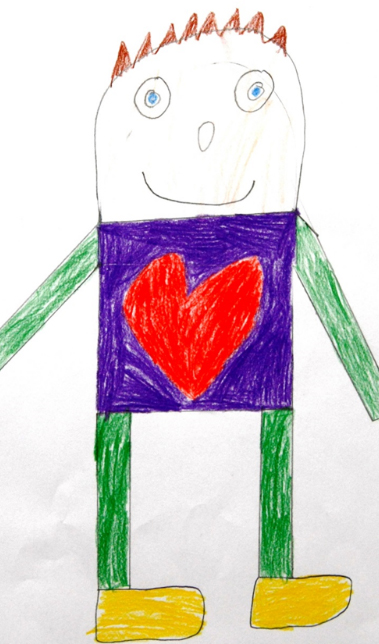
Although they were in very different places, using very different means and methods, all the students agreed: It all comes down to the teacher (with a heart) …
Dr. Petra Koinzer
Project Manager, ZINT Continuing Education and ZINT Network
Phone: 03581 - 374 42 58
Email: p.koinzer@hszg.de