
11. January 2017
Final workshop in Dresden
The HSZG Environmental Management Team presented the “Modular System for a Sustainable Campus” as a suitable tool.
A little over two years ago, Zittau/Görlitz University of Applied Sciences decided to expand its environmental management system into a sustainability management system. Together with the Environmental Management team at the Technical University of Dresden (TUD), our university’s Environmental Management working group has developed a “Modular System for a Sustainable Campus.” The “modular system” tool consists of five components: framework, framework elements, areas of action, building blocks, and building block criteria.
The modular system more clearly reflects the specific characteristics of universities (e.g., teaching, research) than was the case with an EMAS-compliant environmental management system.
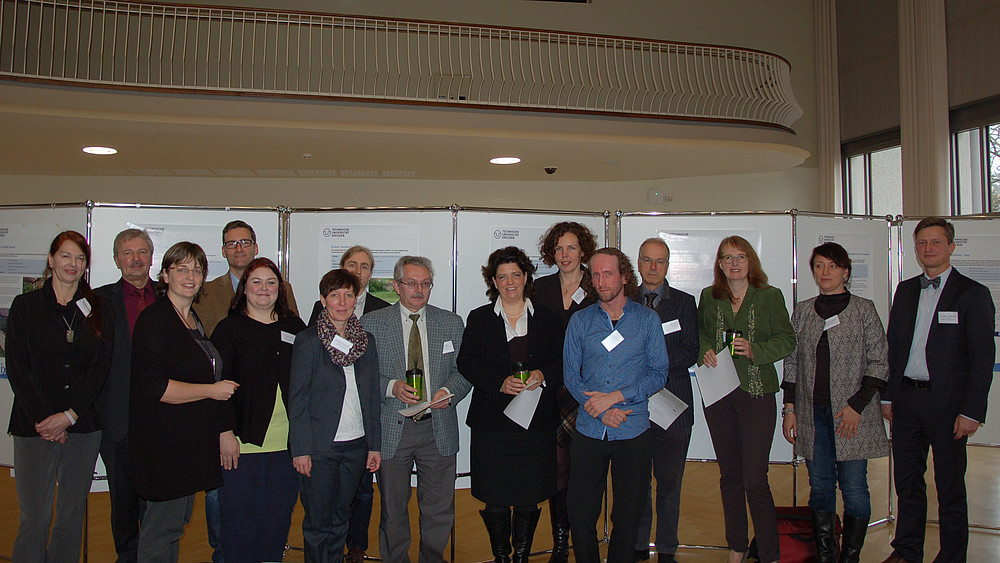
At the project’s concluding workshop, which took place on November 24, 2016, at TUD with the participation of our Vice President for Education and International Affairs, Prof. Dr. Heidger; the Chancellor of TUD, Dr. Handschuh; the project sponsor SMWK (represented by Mr. H. Jaekel), as well as representatives from five other Saxon universities, the product was presented to its actual target audience for the first time. Ms. Kerstin Kräusche, Sustainability Officer at the Eberswalde University for Sustainable Development (HNE), delivered a keynote address as a key expert in the field, thereby enriching the event in a special way.
The joint project team from HSZG and TUD explained the structure and implementation of the “Sustainable Campus” toolkit, which is maintained using an Excel tool. The toolkit is structured to take into account the requirements and key elements of management systems based on the High Level Structure (HLS), in particular ISO 14001/EMAS, 50001 and 45001, as well as the university-specific German Sustainability Code (DNK) for sustainability reporting.
This is of interest to Saxon universities because, at the meeting of the State Conference of University Presidents (LRK) on October 10, 2016, the topic “Sustainable Campus” was defined by resolution as an important area of development for universities and colleges, and starting in 2017, financial resources will be made available to higher education institutions through the initiative budget to implement the “Sustainable Campus” initiative.
Feedback from the other Saxon universities on the modular system was consistently positive. It is viewed as a suitable tool for establishing a sustainability management system and implementing sustainability reporting. The representative from the Eberswalde University for Sustainable Development praised the modular system as a “…very sophisticated system that is both in-depth and comprehensive.” In addition, it gives educational institutions the necessary flexibility to incorporate their own existing and new aspects into sustainability management. All in all, an impressive and outstanding achievement that should be of interest to many institutions of higher education. And Eberswalde would like to test the system.”
The HSZG’s Environmental Management team will implement the modular system at the university starting in 2017 and also plans to transfer the concept to other Saxon universities as part of a consortium project. Following the final workshop, two other universities—in addition to the HNE—spontaneously expressed interest in collaborating (including the TU Bergakademie Freiberg).
Furthermore, the HSZG Environmental Management team is a project partner in the nationwide BMBF-funded project “Sustainability at Universities: Develop—Network—Report (HochN),” which brings together 10 universities across Germany with the goal of implement and professionalize sustainability management and reporting at universities.
Faculty of Natural and Environmental Sciences
02763 Zittau
Theodor-Körner-Allee 8
Building Z IVa,
Room A0.08
First floor
First floor
+49 3583 612-4751