
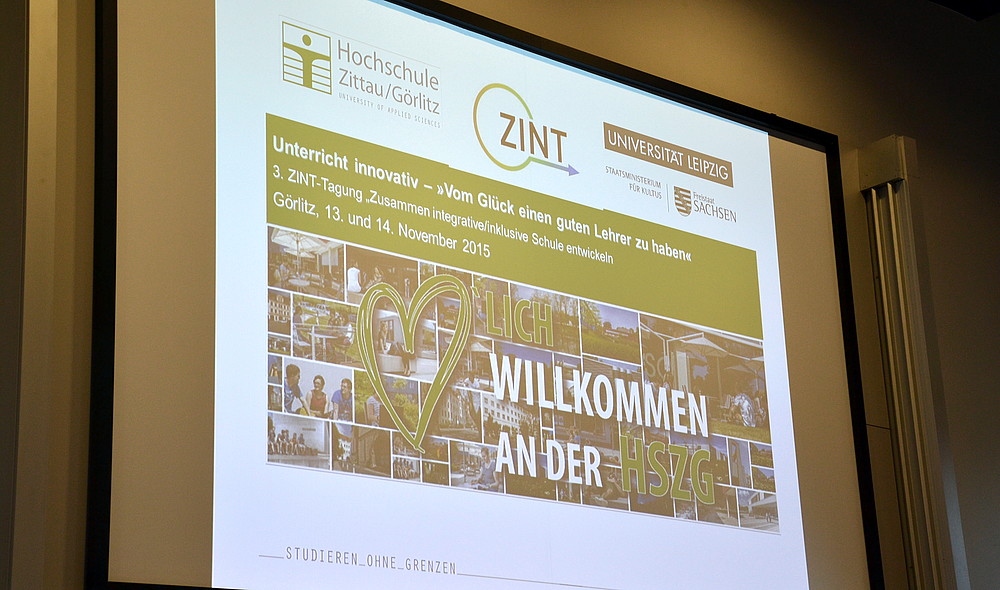
As part of the “ZINT—Developing an Integrative/Inclusive School Together” project, the third workshop for former and current participants of the ZINT course took place on November 13 and 14, 2015, at Zittau/Görlitz University of Applied Sciences under the title “Innovative Teaching!—The Joy of Having a Good Teacher.” This continues a tradition of teacher professional development that began in 2013.
Dr. Petra Koinzer, project manager for networking and professional development in the ZINT project, together with Prof. Dr. Matthias Schmidt, the associate dean of the Faculty of Social Sciences, welcomed the participants to the conference, which took place in both lecture halls for the first time. As moderator, Prof. Dr. Schmidt, together with the contributors from the individual workshop sessions, skillfully pieced together—in his usual professional manner—a multifaceted overview of the issues and challenges involved in designing instruction for integrative/inclusive learning groups.
Prof. Dr. Friedrich Albrecht, as Rector of Zittau/Görlitz University of Applied Sciences and project director of the overall project, welcomed the participants and presented the third phase of the ZINT project, which is being carried out from 2016 to 2018 at the university’s Institute for Education, Education, Information, and Communication (BIK) at the university, with its individual components. At the same time, he conveyed greetings from the Vice Rector for Education and International Affairs at the University of Leipzig, representing the project partner.
As the keynote speaker, Wolfgang Endres—a learning methods specialist, developer of the Endres Learning Method, and teacher trainer at and the Studienhaus St. Blasien—addressed the following questions: “How do you recognize good teaching, and how do you ensure you have motivated students and cooperative parents?” He captivated the educators and education experts in attendance and inspired the seminar participants with his remarks on “Resonance Pedagogy—Balancing Empathy and Leadership.”
His expert presentation was complemented by Dr. Tuyet Helmke from the University of Konstanz, who derived practical strategies for everyday teaching from the findings of the Hattie Study and introduced evidence-based methods for instructional assessment and development (EMU).
A lively exchange of experiences
took place
among integration advocates, those responsible for integration in Saxon schools, representatives of the school supervisory authority, and experts from universities, colleges, and the field during a symposium titled: “Designing Inclusion-Oriented School Learning Programs—Together We Can Succeed,” complemented the topics covered in the practical seminars on lesson planning in heterogeneous learning groups.
The seminars offered a selection of the following key topics for in-depth exploration: Ways to Ensure Successful Communication in the Classroom with Sara Jablonski; Supporting and Challenging Students in Foreign Language Instruction with Dr. Frank Haß; Systemic Observation and Solution-Oriented Action in Inclusive Schools with PD Dr. Holger Lindemann; Achieving Learning Success Through Differentiation in “Minor Subjects” with Dr. Andrea Rendel, or “Thinking About Inclusion from the Child’s Perspective” with Prof. Dr. Petra Büker and Christine Weiß; and, specifically for participants from vocational schools, “Individual and Continuous Support in Vocational Education Through the Assisted Training (AsA) Concept” with Simone Kessler and Janet Köhler.
At a “Market of Opportunities,” organized in cooperation with various partners, the conference also offered the 180 participants—from all types of schools and regions across Saxony, as well as staff from the school supervisory authority—learning experiments, literature, professional development opportunities, and support services for inclusion-oriented lesson planning.
The first day of the conference came to a wonderful close in the evening at the Bürgerstübl with the “Meet and Talk ” event, which provided an opportunity for exchange as well as for making new connections and strengthening existing ones—thanks in part to the entire restaurant team led by Ms. Carmen Schade. The students from the Astrid Lindgren School, a school for students with intellectual disabilities in Weißwasser, together with their teachers, delighted the educators and speakers in attendance in the Jacob Böhme Hall with their play “The Little Lion and His Friends,” which addressed the topic of accessibility, and their enthusiasm for performing.
On the second day of the conference, regional networking took center stage. Following a keynote presentation by Jörg Heidig on the dynamics of change processes and the opportunities for cooperation and collaboration within networks, the participants broke into their regional network groups to reach an agreement on how to further shape their collaboration during the 2015–2016 school year and to share their experiences.
We would like to extend our special thanks to Sandro Hänseroth for documenting the conference and moderating the session in Lecture Hall 2, as well as to Mr. Möldner for his technical support. Thanks also to the helpful support from the project team and the assistance provided by the students in organizing and documenting the conference, the event was a complete success.
Thanks also go to the custodians, Mr. Otto, Mr. Zucker, and Mr. Zenker, as well as Ms. Krusche, for their support in organizing the conference. We would also like to thank the Kelichhaus catering and food service in Görlitz for the delicious meals provided during the conference.
During the conference, dedicated educators from all types of schools were able to deepen their subject knowledge, share experiences, and expand their own skills with the goal of working together to find ideas and solutions to overcome challenges on the path toward inclusive school development.
We would like to thank Zittau/Görlitz University of Applied Sciences for its support of the conference and look forward to the 4th conference in fall 2016, which will feature new topics on integrative/inclusive teaching and school development.
Photos: Sandro Hänseroth
Contact:
“ZINT Project: Developing an Integrative/Inclusive School Together”
Institute for Education, Information, and Communication
Dr. Petra Koinzer
Phone: 03581/374 4258
Email: p.koinzer@hszg.de